Feet Tickling: Why Feet Are Ticklish & How to Do It Safely
Transparency note: FeetFinder publishes this guide and mentions its own platform. Scientific claims rely on independent research, while platform statements reflect FeetFinder's current published policies, which can change, so always verify any platform yourself.
Quick answer: Feet are often ticklish because the nervous system responds strongly to external touch on the soles. Current research suggests that ticklishness is not simply determined by nerve density: body areas that receive less everyday touch tend to be more ticklish, and individual responses vary considerably. Because laughter does not necessarily mean enjoyment, tickling should always be consensual and easy to stop.
Feet tickling is a widely shared human experience. A 2026 study published in Nature Human Behaviour examined 448 adults from Chinese, Dutch, and Greek cultural backgrounds and found that 98.4% had been tickled at least once, while 95.8% had tickled someone else.
The rates were similarly high across all three groups, supporting the researchers' conclusion that tickling shows broadly consistent patterns across the cultures studied.
Laughter was the most commonly reported reaction, alongside resisting, escaping, tickling back, screaming, and smiling. Importantly, laughter during tickling should not be treated as proof that someone wants the experience to continue.
But what's actually happening when someone tickles feet? And what, if anything, does being ticklish say about your health?
This guide focuses on the science and safety: why feet are ticklish, which spots react most, why you can't tickle yourself, what changes in sensation may indicate, and how to keep tickle play consensual. For the hands-on, step-by-step version, we link to our how-to guides along the way.
|
Finding |
2026 study |
|---|---|
|
Participants studied |
448 adults |
|
Age range |
18–30 years |
|
Had been tickled at least once |
98.4% |
|
Had tickled someone else |
95.8% |
|
Moderately to very ticklish |
71.0% |
|
Cultural groups studied |
Chinese, Dutch, Greek |
|
Common ticklish regions |
Foot soles, armpits, neck, abdomen |
What Is Feet Tickling?
Feet tickling is lightly touching, stroking, or brushing the sole, toes, or arch to trigger a ticklish response, usually laughter, a reflexive pull-away, or both. It's part playful reflex, part neurological quirk, and for many people a genuine source of relaxation and connection.
Knismesis vs. Gargalesis: The Two Kinds of Tickle
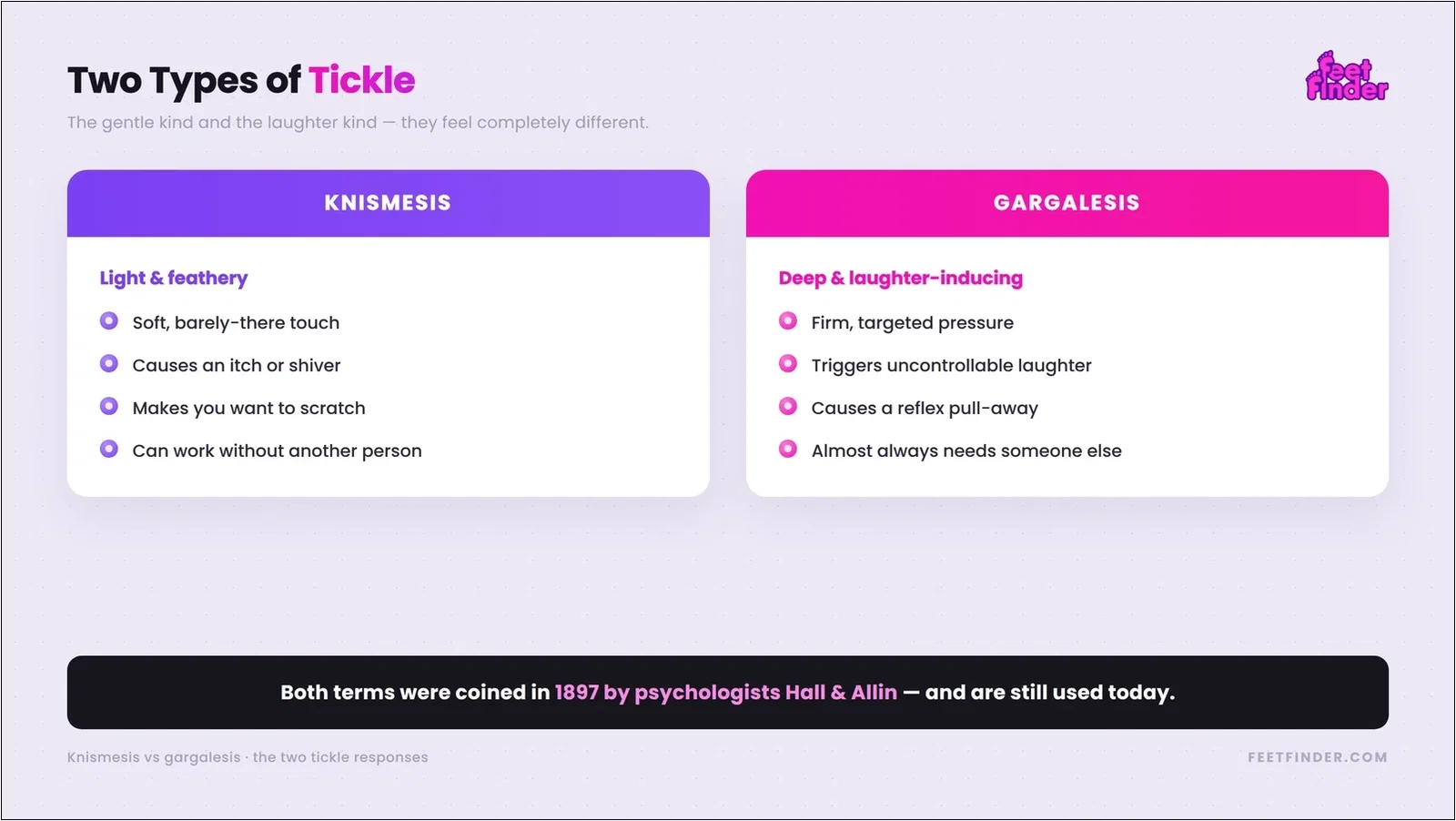
There are two distinct kinds of tickle at work, and knowing the difference explains a lot. A soft, feather-light touch that causes a mild itch or shiver is called knismesis.
The harder, laughter-inducing kind, the one people mean when they yell "stop tickling my feet!", is called gargalesis.
Both terms were coined back in 1897 by psychologists G. Stanley Hall and Arthur Allin, and researchers still use them today.
The two feel completely different. Knismesis is quiet and a little annoying, like a bug crawling across your skin, making you want to scratch or move away rather than laugh.
Gargalesis is loud and social: it produces that uncontrollable giggle and usually needs external, unpredictable touch, most often from another person. That's why one type of feet tickle can soothe while the other leaves you gasping for someone to stop.
Gargalesis is also the version that shows up in requests to creators selling feet pics and clips, since the loud, unpredictable reaction is what makes it watchable.
That's worth knowing before agreeing to it. The reaction is involuntary, so a stop signal needs to be agreed in advance rather than improvised mid-take.
|
Aspect |
Knismesis |
Gargalesis |
|---|---|---|
|
Feels like |
Light itch or shiver |
Uncontrollable giggling |
|
Touch needed |
Feather-light graze |
Firmer, repeated touch |
|
Reaction |
Scratch or move away |
Laughter and squirming |
|
Who can trigger it |
Yourself or another person |
Almost always another person |
|
Common on feet |
Soft brush across the arch |
A hand or tool on the sole |
Why Are Feet So Ticklish?
Feet are ticklish because ticklishness is a distinct sensory response shaped by how the nervous system processes unexpected touch—not simply because the soles have a large number of nerve endings.
A 2026 Nature Human Behaviour study involving 448 adults across three cultural groups found that ticklishness has a consistent body map that differs from ordinary touch sensitivity, pain and pleasure. One of the strongest associations was touch exposure: body regions that are touched less often tended to be more ticklish. The researchers found that no single anatomical theory fully explains why particular areas are ticklish.
The soles are richly supplied by sensory nerves, but current research suggests that nerve density alone does not explain why feet produce such strong tickle responses.
|
Finding |
Evidence |
|---|---|
|
Tickling is widespread |
98.4% of 448 participants had been tickled |
|
Feet/soles are common ticklish areas |
Consistent across three cultural groups |
|
Nerve density alone doesn't explain it |
Ticklishness had a distinct body map |
|
Less-touched areas tend to be more ticklish |
Supported in the 2026 cross-cultural study |
|
Self-touch is less ticklish |
Supported by sensory-attenuation research |
|
Laughter ≠ enjoyment/consent |
Tickling can be pleasant or unpleasant |
The Most Ticklish Spots on the Feet
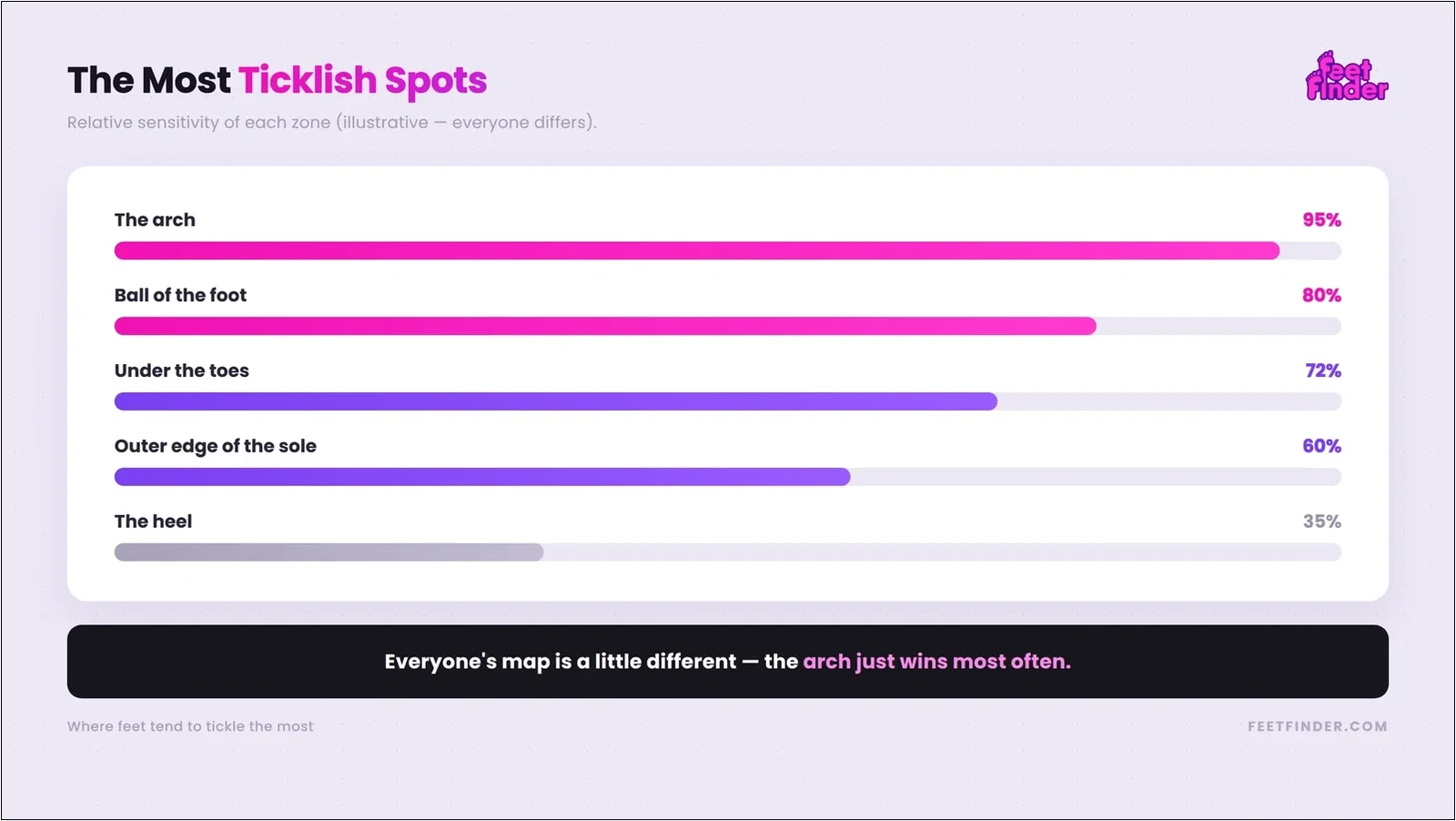
There isn't one universally "most ticklish" spot; research is limited and responses vary a lot. In one small 2022 study (the University of Auckland's TickleFoot research, just 13 participants), women rated the center of the arch highest and men an area nearer the toes, far too small a sample to treat as a universal map.
With that caveat, these are the areas people commonly find sensitive:
The arch. One recent study found that, across the body, areas receiving less everyday touch tended to be more ticklish. That may help explain why some parts of the sole react strongly, although it does not fully explain individual differences.
The ball of the foot. Just below the toes, this padded area is a high-sensitivity strip that reacts strongly to light strokes.
Under and between the toes. Small, delicate, and easy to reach, a reliable spot for many people, though some find it too intense.
The outer edge of the sole. A surprising trigger zone that catches a lot of people off guard.
The heel. Generally the least reactive area because the skin is thicker, but it's still sensitive for some.
Everyone's map is different; some can't stand toe contact but don't mind the arch, and others are the opposite.
Individual sensitivity varies considerably, so a spot that produces a strong response in one person may barely affect another.
Why Do We Laugh When We're Tickled?
We laugh because tickle-laughter is an involuntary reflex, not a straightforward signal of enjoyment. It looks like joy, but the two aren't the same thing, and that distinction matters more than it seems.
Researchers link laughter and social play to the brain's reward and bonding systems, though direct measurements of foot-tickling chemistry in humans are limited.
Spontaneous laughter has been associated with reductions in cortisol in some studies, but those findings should not be interpreted as evidence that foot tickling itself is a stress treatment. Research specifically measuring hormonal changes during foot tickling is limited.
Because gargalesis almost always involves another person, it's tied to trust and closeness, a big reason it can feel good beyond the physical sensation. It's also part of why some people find feet appealing, which we dig into in our piece on why people are attracted to feet.
Here's the important part: that laughter is involuntary, and for some people gargalesis sits right on the edge between pleasure and too much.
It can flip from delightful to overwhelming in seconds, so someone can be laughing hard while wanting it to stop, which shapes everything about doing this safely.
Can You Tickle Your Own Feet?
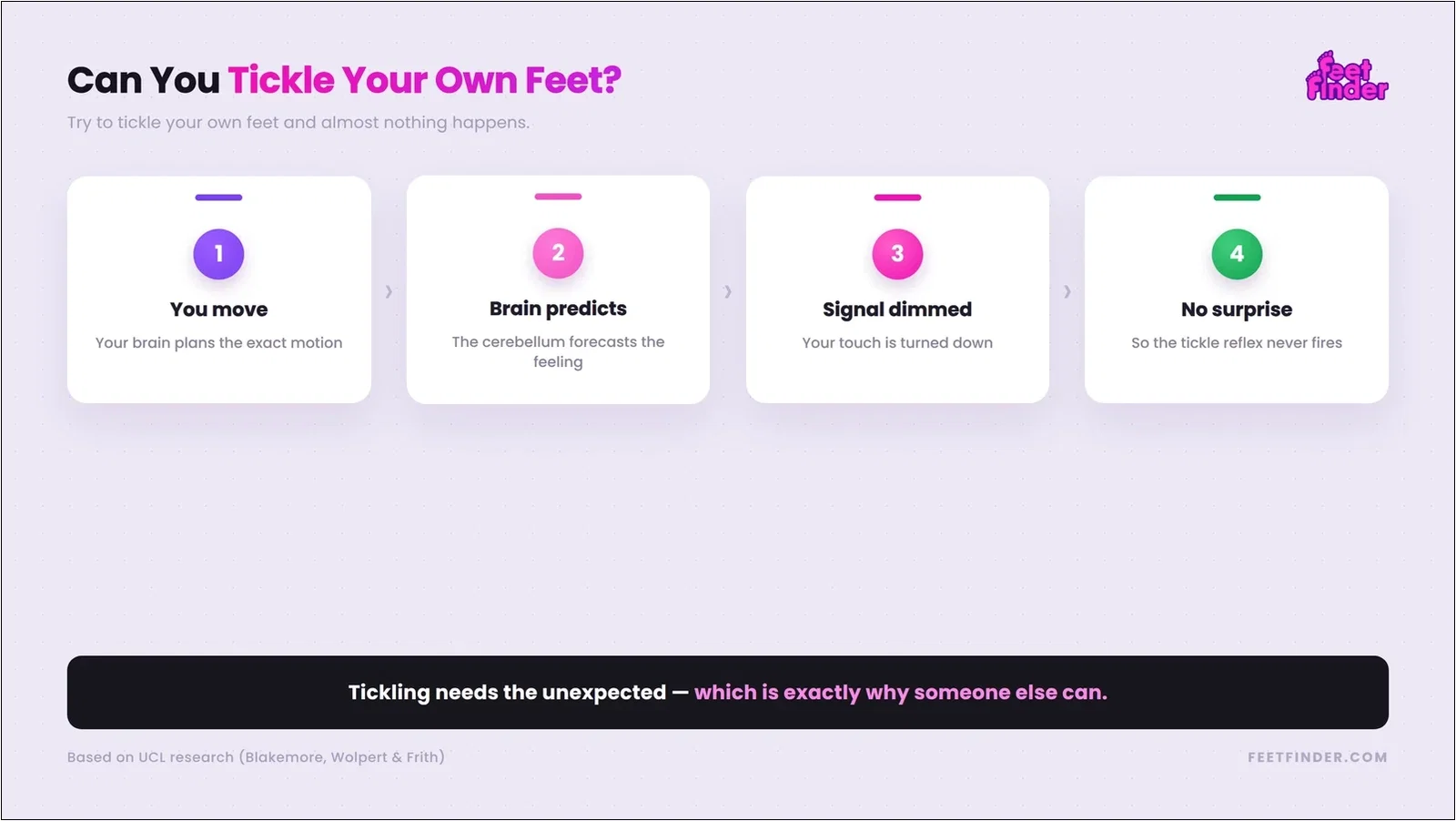
Try to tickle your own feet and almost nothing happens. That's not your imagination, it's your brain being efficient.
People searching for how to tickle your own feet often find that self-generated touch produces a much weaker response because the nervous system can predict it.
The cerebellum predicts the sensory consequences of your own movements and dampens them before you notice. Your brain already knows what your hand is about to do, so it turns the volume down, and you simply can't surprise yourself.
This is the same reason Darwin's 1872 observation still holds: tickling needs unpredictability and, usually, someone else's hand. Your own touch is too expected to trigger the reflex.
To get closer, remove the predictability: a soft brush dragged in random patterns, a textured surface, or a small tickling tool beats your own fingers. Even then, it rarely matches the intensity of someone else doing it.
What Does It Mean If My Feet Aren't Ticklish?
Usually, nothing. Low ticklishness on its own is normal and varies day to day, shaped by genetics, mood, and how relaxed you are, so a weak reaction rarely means anything is wrong.
What's worth attention is change. A new or lasting drop in foot sensation, numbness, or tingling can sometimes point to nerve issues such as peripheral neuropathy (which has many causes, including diabetes), and it also makes injuries harder to notice.
None of this is something a tickle test can diagnose, and this guide isn't medical advice. But if you notice a real, lasting change in how your feet feel, it's reasonable to mention it to a doctor.
Foot Tickling Techniques and Tools
The mechanics are simple, and they come back to one principle: unpredictability. Light, varied, hard-to-predict touch triggers the strongest response, while firm or repetitive pressure dulls it, and tools like fingers, a clean feather or a soft brush.
That's the short version. For the full step-by-step walkthrough, best tools, and tips on finding a partner's most sensitive spots, see our guide to tickling feet; just keep tools clean, avoid broken skin, never use force, and stop at any pain or numbness.
Safe Foot Tickling: Consent and Boundaries
Safe foot tickling comes down to one simple rule: it should always be wanted, and it should always be easy to stop.
Tickling is unusual because the reaction is involuntary, so someone can be laughing hard and still want it to end immediately. Laughter is not the same as consent, and that's the single most important thing to understand about feet tickling.
Here are the consent and boundary basics worth building into any tickle play:
Ask first, every time. Look for enthusiastic agreement, not silence or assumption.
Agree on a stop signal. A clear word or gesture that means pause now, useful because the person may be laughing too hard to speak. Honor it instantly.
Check in as you go. A quick "still good?" keeps everyone comfortable and builds trust.
Never restrain someone who hasn't agreed to it. Holding feet or ankles down changes the dynamic and requires its own explicit consent.
Respect the answer. Some people adore being tickled, some genuinely hate it, and both responses are valid. "No" is a full sentence.
Far from being a mood-killer, consent is what makes feet tickling feel safe enough to actually enjoy.
Safe vs. unsafe tickling at a glance:
|
SAFE TICKLING |
UNSAFE TICKLING |
|---|---|
|
✓ Ask first, every time |
✗ Assuming it's welcome |
|
✓ Agree on a clear stop signal |
✗ Ignoring the word 'stop' |
|
✓ Check in as you go |
✗ Restraining without consent |
|
✓ Stop the instant they ask |
✗ Treating laughter as a yes |
|
✓ Keep it light and playful |
✗ Going too hard, too fast |
|
✓ Respect a 'no' fully |
✗ Pushing past their limits |
Laughter isn't consent. Always agree on a stop signal first.
The same principle carries over online: the best experiences with foot content happen where consent and verification are the foundation, not optional extras.
Is Feet Tickling a Kink?
For some adults, tickling can also have a sexual or fetish-related dimension. A consensual interest between adults is a matter of personal preference; consent, boundaries and applicable platform rules still apply.
We won't go deep on the fetish side here, since it deserves its own space, so read our full breakdown in the guide to the foot tickling fetish.
It sits alongside other forms of foot appreciation like foot worship and feet play in BDSM.
The short version: as long as it's consensual and strictly between adults who meet the legal age requirements in their jurisdiction, exploring what you enjoy is healthy and valid.
Exploring Feet Tickling Content Safely
When comparing feet tickling websites, look for platforms that clearly explain age verification, consent requirements, privacy practices, payment rules, content restrictions, and reporting procedures.
Ticklish-feet videos, playful reaction clips, feather play, and other foot-focused tickling content form a distinct niche within online foot-content communities.
For adults who choose to explore it, the important question is not only what content they enjoy, but whether it is created and shared with clear consent, age verification, and appropriate safeguards.
Not every platform handles those issues in the same way. Before buying, selling, or uploading tickling content, check whether the service clearly explains its age-verification process, consent requirements, privacy practices, payment rules, content restrictions, and reporting procedures.
Safety You Can Verify
Sell on a platform that verifies every creator
FeetFinder requires all sellers to be adults and to complete identity and age checks with a government-issued ID. If anyone else appears in your content, you must confirm their age and identity and keep written records of their prior, informed consent to appear in and distribute the content.
For FeetFinder Creators
Any foot-tickling content uploaded to FeetFinder must comply with the platform's current Seller Agreement and Acceptable Use Policy. Everyone depicted must be an eligible consenting adult, and creators must maintain the required age-verification and consent records.
FeetFinder's current rules prohibit content involving nonconsensual pain, torture, sadomasochistic abuse, hardcore bondage, sexual assault, and other prohibited categories, and non-live seller content is reviewed before publication for compliance.
Buyers can also read our guide on how to buy feet content, while creators looking for permitted content ideas can explore our guides to foot fetish content ideas and formats such as ASMR feet content.
Common Myths About Ticklish Feet
There's a lot of folklore around tickling feet. Let's clear up a few of the most common myths:
"Being ticklish means something is wrong." Not so, and neither does not be ticklish; ticklishness alone says nothing about nerve health. A new or lasting change in foot sensation is what's worth mentioning to a doctor.
"You can train yourself to not be ticklish." You can dampen the reaction by staying relaxed or placing your own hand over the tickler's, but you usually can't switch off a nervous-system reflex.
"Ticklishness is the same for everyone." Not even close. It varies by person, by spot, by mood, and by day.
"If you're laughing, you're enjoying it." Laughter during tickling is involuntary and not a reliable sign of enjoyment. Rely on words and agreed signals, not giggles.
"You can tickle yourself if you try hard enough." Your cerebellum has other plans. Self-tickling is neurologically dampened by design.
Frequently Asked Questions
Why are my feet so ticklish?
Feet ticklishness is produced by how your nervous system responds to unexpected external touch. A 2026 cross-cultural study found that ticklishness is distinct from ordinary touch sensitivity and tends to be stronger in body regions that receive less everyday touch. Individual responses still vary considerably.
What are the most ticklish spots on the feet?
Sensitivity varies widely. The arch, ball of the foot, and under the toes are usually most reactive and the heel least; one small 13-person study found women peaked at the arch's center and men nearer the toes, so treat it as a hint, not a rule.
Why can't I tickle my own feet?
Your cerebellum predicts your own movements and mutes the sensation, so there's no surprise for your brain to react to.
Tickling needs unpredictability, which is why it works best when someone else does it.
Is it bad if my feet aren't ticklish?
Usually not. Low ticklishness on its own is normal and varies day to day; what's worth attention is a lasting change, such as new numbness or loss of feeling, which is worth mentioning to a doctor.
Is feet tickling safe?
Yes, when it's consensual and gentle. Keep it light, agree on a stop signal, and stop immediately when asked, even if the person is still laughing.
Where can I explore feet tickling content safely?
Look for platforms that clearly explain age verification, consent, privacy, payment processing, and content reporting, and review those policies before buying or uploading anything.
Why Does Tickling Feet Feel Good?
For some people, tickling can feel playful or enjoyable because it combines unexpected touch, laughter, anticipation, and social interaction. However, responses vary considerably, and laughter itself does not prove enjoyment or consent.
Final Thoughts
Feet tickling is a lighthearted, deeply human thing, rooted in real biology, wrapped up in trust and laughter, and enjoyed by a huge community in all sorts of ways.
Whether you're here for science or safety, the same principles apply: stay curious, stay consensual, and keep a little surprise in the mix. And whenever feet content enters the picture, choose spaces that treat safety and verification as the starting point.
Reviewed & written by
Trevor
Trevor specializes in creating practical how-to guides for new content creators. His work focuses on profile optimization, attracting buyers, avoiding common mistakes, and understanding platform policies. Rather than relying on marketing claims, he emphas
Knock Knock!! Let Your Feet Earn Money
Join thousands of users who are making money by buying and selling feet pictures in a safe, secure platform. Start your journey today with FeetFinder's trusted marketplace.