Foot Worship: Depth Guide Based on History and Modern Research
For millions, feet are more than just a part of the body. We all know they represent beauty, intimacy, trust, respect, and emotional connection. But the idea of foot worship seems confusing, unusual, or difficult to understand.
Across different cultures, foot worship idealizes devotion and even spiritual significance. Today, it remains one of the most common yet least understood aspects of human attraction.
Search interest for terms like "foot worship meaning" and "foot worship practices" has grown. This reflects broader curiosity rather than just niche interest.
Despite its growing visibility, foot worship remains widely misunderstood. Many people assume it is always sexual. But research, historical records, and psychological studies tell a very different story.
Quick Verdict
“Looking for clear answers about foot worship? You're in the right place. This guide explains what foot worship is, how it started, why people enjoy it, how it differs from a foot fetish, and the myths that often cause confusion. Get a complete understanding of foot worship in one easy-to-read resource.
In this guide, you'll discover the history, cultural significance, and modern practices behind foot worship. Also, get to know the key differences that separate it from a foot fetish.
By the end of this guide, you will understand:
- What foot worship actually means
- How the practice evolved throughout history
- Why do some people enjoy foot worship
- How does it differ from a foot fetish
- Common misconceptions and myths
- Role of communication, consent, and boundaries
Whether you're simply curious or looking to better understand this aspect, this guide aims to provide balanced information.
What Is Foot Worship?
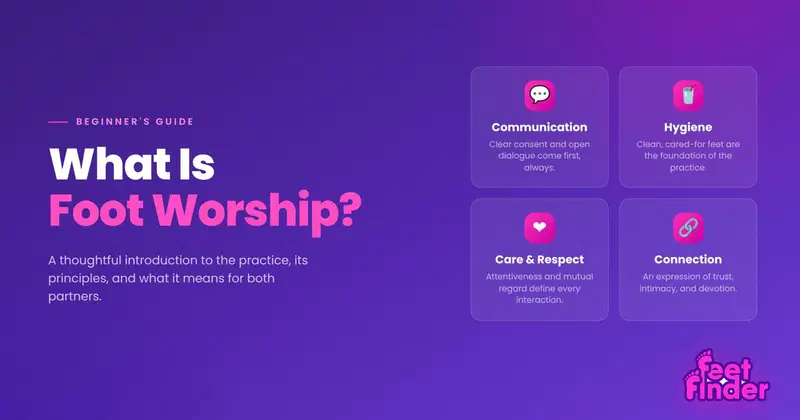
Foot worship is the act of expressing admiration, affection, or symbolic devotion toward a foot. Depending on the involvement, it may carry emotional, cultural, relational, or erotic significance.
Not everyone who practices foot worship is motivated by sexual desire. For some people, it serves as a symbolic gesture. Others may treat it as consensual BDSM dynamics.
The practice can vary widely between individuals and couples. Some view it as an occasional expression of affection. While others incorporate it into long-term relationship dynamics.
Consent remains the defining feature. Like any form of intimate interaction, foot worship depends on mutual agreement and respect for personal boundaries.
|
Aspect |
Definition |
|---|---|
|
Primary Meaning |
A practice of admiring another person's feet. |
|
Nature |
A behaviour or form of expression |
|
Always erotic? |
No, it can be emotional, symbolic, or cultural. |
|
Common Contexts |
Relationships, cultural traditions, or personal preference. |
|
Essential Element |
Mutual consent, communication, and respect. |
|
Same as a Foot Fetish? |
No, have related terms but distinct concepts |
Where Did It Start? A Brief History
Fascination with feet is not a modern or purely new invention. It shows up throughout history and across cultures in very different terms.
In several cultures, touching or bowing to another person's feet was a traditional way to express gratitude. Acts such as washing a person's feet are understood as expressions of service and respect.
In the late nineteenth and twentieth centuries, people began examining why some people were attracted to feet. The conclusion centres on various psychological, emotional, and sensory explanations. There was no single theory explains every individual.
Today, foot worship is understood in a much broader context. Some people see it as a form of intimacy or affection within romantic relationships.
Others practice it as part of BDSM dynamics, while many simply appreciate it as admiration. Among Gen Z, conversations about foot worship have become more open.
This has encouraged people to distinguish myths from facts. They now understand the real consent & the foundation of foot worship.
Why Do People Enjoy Foot Worship?
One of the biggest questions people ask is "What motivates people to practice foot worship? There is no single answer.
Just like people have different hobbies or ways of showing love, some also have different personal preferences. What feels meaningful to one person may not interest someone else.
Researchers believe that foot worship usually develops. This is because of a mix of personal experiences, emotions, and attraction. It is rarely explained by just one factor.
So, let us cover the most common reasons behind this human behaviour.
Emotional Connection
For many couples, foot worship is not mainly about physical attraction. Instead, it is a way to show affection, appreciation, or trust.
Some people enjoy taking care of their partner because it makes them feel closer. Others enjoy receiving that attention because it makes them feel valued.
In these cases, the act becomes a way to express love more than hugging, holding hands, or giving a massage.
Symbol of Respect
Feet have carried symbolic meaning in many cultures for thousands of years. In some traditions, touching another person's feet is a way to show respect or gratitude.
For some people today, foot worship reflects a similar idea. It can be a way of showing admiration, appreciation, or devotion to a partner. The act itself is often less important than the meaning behind it.
In certain relationships, it represents devotion rather than a physical meeting. The meaning varies from person to person and depends on the relationship.
Trust Between Partners
Some couples include foot worship as one of many ways to build trust and strengthen their bond. Because it involves personal boundaries, both people need to feel comfortable and respected.
Like any intimate activity, both partners should say yes or no without pressure. Respecting each other's boundaries is what makes the experience positive and meaningful.
For many couples, the emotional connection matters more than the act itself. When built on trust and consent, foot worship becomes a way to express closeness & bonding.
Personal Attraction
Some people simply find feet attractive. Just as one person may notice someone's smile or hair first, another one may notice their feet.
Psychologists call this a foot preference or a foot fetish when the attraction becomes a part of a person's personal interest. However, these two terms are not the same.
Some people admire well-groomed or healthy-looking feet. Others simply see feet as another attractive part of the body. Personal attraction is shaped by individual experiences, not just a single statement.
Varies By Meaning
Not every preference has a scientific explanation. Sometimes, people enjoy certain activities because they feel meaningful or bring them closer.
Everyone experiences relationships differently, so what feels meaningful to one couple may not have the same importance to another.
What matters most is how both partners feel about it. Mutual respect and understanding give the activity its meaning.
Who Are Foot Worshippers?
Another common question is "Who practices foot worship?" The simple answer is people from many different backgrounds.
There is no single type of person who enjoys foot worship. Research and surveys suggest that people with this interest include adults.
It is usually a private part of their personal life rather than something they discuss openly.
Couples
Many people who practice foot worship are couples in healthy relationships. For them, it is one of many ways to express affection or emotional closeness.
Just as some couples enjoy holding hands or sharing smiles, others include foot worship as part of their connection.
It does not define the entire relationship. Instead, it becomes a small way to show care or a romantic gesture.
Every relationship is different. What matters most is that both partners feel comfortable and enjoy the experience together.
BDSM Community
Foot worship is also found within some BDSM relationships. In these situations, it may become part of agreed roles involving dominance.
However, this is often misunderstood. Healthy BDSM relationships are built on communication and mutual agreement.
Partners openly discuss what they enjoy, their boundaries, and what they are not comfortable doing.
The focus is always on
- Mutual consent
- Honest communication
- Respect for personal boundaries
- Safe practices
- Trust between partners
For many people in this community, foot worship is simply one activity among many. It is not required, and not everyone who practices BDSM includes it in their relationship.
Curious Beginners
Not everyone who explores foot worship becomes deeply interested in it. Many people learn about it through documentaries, social media, or conversations.
Curiosity is completely normal, especially when people encounter topics they have never heard about before.
Some may read more to understand psychology. Others might discuss it with their partner without ever trying it themselves.
Being curious does not mean someone develops a long-term interest. For many people, it remains nothing more than a topic they want to understand.
People With a Foot Fetish
Some people who have a foot fetish also enjoy foot worship, but the two terms are not identical.
A foot fetish refers to a strong sexual attraction to feet. Foot worship is a behaviour or activity. People may participate in it for different reasons. This may include attraction, emotional closeness, symbolic meaning, or relationship dynamics.
This distinction is important because many people assume that everyone who practices foot worship has a foot fetish. In reality, some do, while others do not.
Where Do Foot Worshippers Meet Online?
While there are many online communities discussing feet, finding a trusted platform with verified users can be difficult.
FeetFinder has become one of the best-known platforms for people interested in foot content. Buyers can browse creator profiles, while creators can earn money by selling photos, videos, custom requests, and subscriptions.
FeetFinder was built specifically for this niche, making it easier for both buyers and sellers to find one another.
In summary, foot worship practices by a diverse range of adults. They come from different backgrounds, hold different beliefs, and have different relationships.
There is no "typical" foot worshipper. Like many interests, it is shaped by individual preferences, mutual consent, and the dynamics of the relationship.
Explore FeetFinder
How Is Foot Worship Practised?
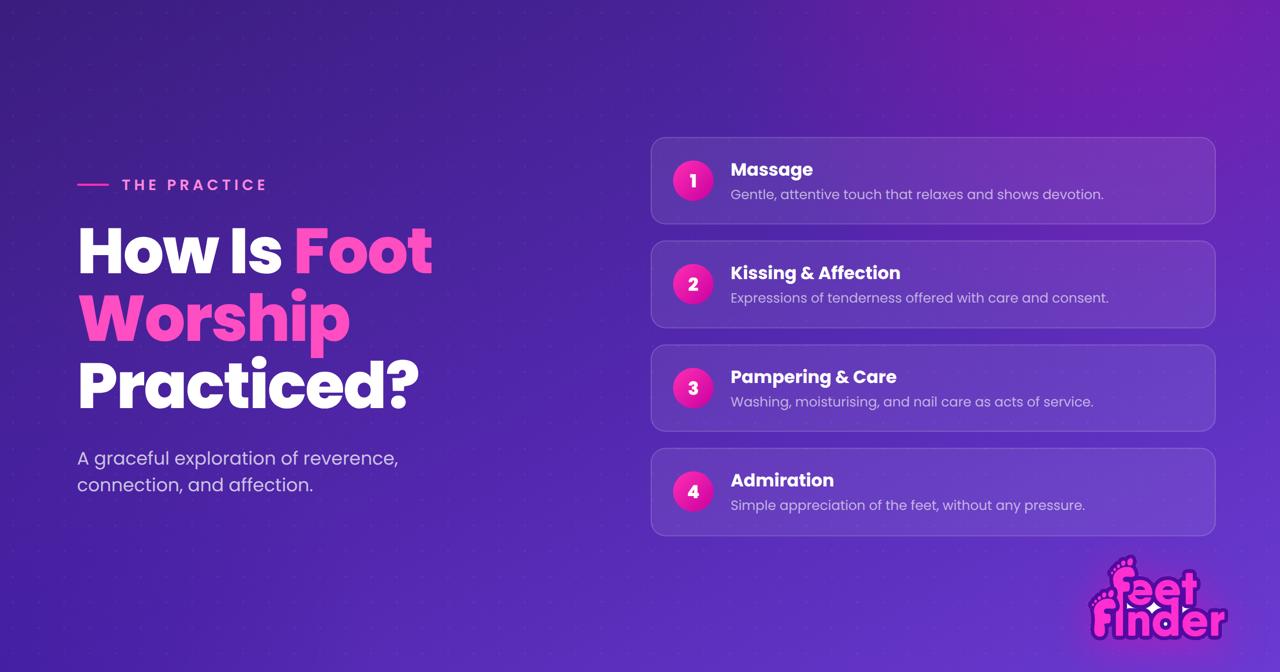
There is no single way that people express foot worship. Like many forms of intimacy, it varies from person to person and from relationship to relationship.
What matters most is that both people understand each other's boundaries. They must freely agree on what they are comfortable with.
The meaning behind these actions is often more important than the action itself.
Foot Massage
This is the most common entry point. It involves using the hands to apply pressure and stretch the arches, heels, soles, and toes of the feet.
What it involves: Massaging from the heel toward the toes gives a soothing expression. When you apply thumb pressure to the arch, rotate the ankle, and gently pull each toe, it creates a sense of pleasure.
Why people are drawn to it: For many, this is about relaxation and care. It's a way to physically tend to a partner. Feet have a high concentration of nerve endings, which is why a foot massage can feel more intense.
Light Lips Touch
This practice centres on the feet, top or bottom, rather than the hands. Applying a lip gesture to the arch, the ankle, or individual toes can feel meaningful to the partner.
What it involves: Gentle or slow kissing paired with light stroking or holding the foot in place. Some people incorporate this into a broader pattern. While others treat it as a distinct but focused act.
Lip gestures carry strong symbolic weight. It's an act typically reserved for faces, hands, or intimate areas. So applying it to the feet can feel like a deliberate angle of an overlooked body part.
Why people are drawn to it: In some contexts, kissing the feet is often the clearest physical expression since it makes an impactful, respectful gesture.
Licking and Toe Sucking
This involves the mouth and tongue applied directly to the foot. This can include licking the sole, wrinkled soles sucking, or tracing the arch with the tongue.
What it involves: This is often done very slowly because it affects the partner’s nature. However, it can sometimes start with lip-pursing before progressing to licking or sucking.
Why people are drawn to it: Because it involves direct oral-to-skin contact, hygiene is especially relevant. Research on foot fetishism notes this as one common act among people.
Scent-Focused Worship
A practice involves smelling the feet, often with socks on, with shoes on, or bare. This can range from a brief acknowledgement of scent during a massage or another activity.
What it involves: For instance, smelling feet after they've been in shoes all day may seem bad as it affects your health. But everyone has their personal desires, so they must know about the scents.
Why people are drawn to it: This is more common than most people assume.
In a 1994 study of 262 men from a gay and bisexual foot-fetish organization, about 45% reported arousal related to smelly socks or foot odor (Weinberg, Williams & Calhan, 1994). That figure describes that sample—not everyone with any foot interest.
Sock and Shoe Worship
This practice focuses on items associated with the feet. It can be socks, stockings, shoes, or boots rather than the bare foot itself.
What it involves: This might mean smelling, licking, or handling worn footwear. You can watch a partner remove shoes or socks as a moment to remember. However, a focus on stockinged or socked feet before on bare skin.
Why people are drawn to it: Object-focused interest is extremely common within foot-related fetishism. This makes up a substantial share of fetish communities online.
For some people, the object (particularly when worn) carries more charge than the foot beneath it. As it combines scent and the idea of something intimately worn.
Trampling
A physically intense practice in which one partner applies body weight to another, using the feet as the primary contact.
What it involves: This ranges from light stepping on the back or chest. This can be done barefoot and sometimes with nails or boots for added sensation.
It requires real physical care to communicate about pressure. Partners should avoid vulnerable areas (such as the stomach or throat). They can also use a word when physical risks are involved.
Why people are drawn to it: Trampling sits at the intersection of foot-focused interest and power dynamics. The physical weight involved makes it more explicitly dominance-oriented practices.
Content-Based Worship
An increasingly common modern variation in which the practice occurs without in-person contact. This can be done through photos, videos, or live video calls.
What it involves: One person shares images or footage of their feet. This sometimes includes performing specific acts, such as wearing certain shoes or adopting specific poses. Another person's viewing pleasure is what makes this a moderation.
Why people are drawn to it: This format separates the visual component of foot interest from the physical element. This has grown substantially as a distinct category alongside in-person practices. It appeals especially to people whose interest is primarily visual.
|
Practice |
What Involves |
Why Liked By People |
|---|---|---|
|
Foot Massage |
Hand massage across feet and toes. |
Relaxation, comfort, and caring touch. |
|
Light Lip Touch |
Soft kisses or lip gestures on feet or toes. |
Symbolizes affection, admiration, or devotion. |
|
Licking and Toe Sucking |
Oral contact with feet or toes |
Enhances sensory and intimate experiences. |
|
Scent Focus |
Smelling clean feet, socks, or shoes. |
Appeals to scent-based attraction. |
|
Sock and Shoe Focus |
Admiring or handling worn footwear. |
Combines visual, scent, and emotional appeal. |
|
Trampling |
Controlled stepping over the back or chest with nails. |
Explores trust and power dynamics. |
|
Content-Based Worship |
Photos, videos, or live online interactions. |
Enjoys visual appreciation without meeting. |
Each of these practices can stand alone or be combined. A couple might only ever do foot massage, while another might build a dynamic around trampling.
Make sure to communicate clearly about which of these specific acts each partner is actually interested in.
Things to Consider Before Trying Foot Worship
If two adults are interested in foot worship, there are several important things to think about first. They must be prepared both emotionally and physically to make the experience better for one another.
Talk First
Before anything happens, have an honest conversation about what you're both hoping for. This works best when done calmly & both people can think or speak openly.
Discuss what expectations like "foot worship" mean to each of them. This can vary from person to person. So, when trying any of the foot-worship practices, you must agree to the general idea.
Good communication is the biggest factor in whether the experience goes well. Discomfort arises when a partner assumes something the other never agreed to.
Respect Boundaries
Everyone has different comfort levels. What felt fine last week might not feel right today, and that's completely normal.
Never pressure someone to participate, whether through guilt or by simply repeating a request until the other person gives the green light.
Consent given physically is not t the same as consent given freely. A healthy relationship always respects personal limits.
If a boundary is set, it should be agreed without negotiation. The person who set the boundary should never feel like they need to defend it.
Practice Good Hygiene
Because foot worship often involves direct contact with the lips, mouth, or tongue, hygiene isn't optional. Clean feet help reduce bacteria and the chance of skin infections.
It is better to wash or shower the feet. This makes the experience comfortable for both partners. If either person has open sores or a fungal infection, it's best to wait until the skin heals.
A short delay is a small price for avoiding a genuinely unpleasant health issue.
Understand That Preferences
Not everyone enjoys foot worship, and that's completely normal. Intimate interests vary, and there's no universal standard for what should or shouldn't be appealing.
If one partner is curious and the other isn't interested, that doesn't mean anything is wrong. It simply means their preferences don't align on this particular practice.
People have different interests, and no single preference is more "normal" or "correct" than another.
The goal isn't to convince a partner to come around. But it is to find out honestly where each person actually stands.
Focus on Comfort
Throughout the experience, both partners should feel relaxed and respected. This is not just at the start, but the whole way through. Asking your partner, "Does this foot worship practice still feel good?" will keep things collaborative rather than assumed.
If either person feels uncomfortable at any point, it is okay to stop. There's no obligation to finish something once it's started.
Healthy relationships always value each person's feelings over completing a particular activity. A partner who respects a pause without complaint is highlighting the kind of trust & respect.
Can Foot Worship Make You Money?
Yes, the growing interest in foot worship and foot-related content has created a legitimate online market. This allows creators who are comfortable selling foot media.
Dedicated marketplaces like FeetFinder have made it easier for buyers and sellers to connect in a secure environment. Popular products include:
- Foot photos
- Short videos
- Custom requests
- Photo bundles
- Exclusive content
Some buyers are interested in artistic photography. While others prefer custom content that matches specific requests.
Creators who consistently produce high-quality content and maintain a professional profile are likely to attract repeat customers.
Success depends on more than uploading pictures. The most successful creators often focus on:
- Quality images
- Consistent uploads
- Fair pricing
- Clear communication
- Professional profile
- Privacy protection
FeetFinder provide a marketplace where verified creators can sell feet pics to interested buyers. Features such as identity verification, secure payments, private messaging, and built-in discovery tools help create a safer experience than relying on general social media platforms.
Whether your goal is to make money with your feet or build a long-term foot content business, join FeetFinder now.
Foot Worship vs. Foot Fetish: What Is the Difference?

One of the biggest myths online is that foot worship and foot fetish mean the same thing. But actually, they do not.
The two ideas are closely related, and they can overlap, but they are not identical. The easiest way to understand the difference is this:
- Foot worship is something a person does (behaviour or activity).
- Foot fetish is something a person feels (a pattern of attraction).
Someone can practice foot worship without having a foot fetish. Likewise, someone can have a foot fetish without enjoying foot worship.
For example, a couple may include foot worship in their relationship. Because one partner enjoys showing care, respect, or submission. Neither person may have a strong erotic attraction to feet.
On the other hand, someone with a foot fetish may find feet attractive even if they never practice foot worship with another person. Understanding this difference helps remove many common myths.
Definition of Foot Worship
Foot worship is a consensual activity in which one person expresses admiration, care, respect, or devotion toward their partner.
Depending on the couple, it may have emotional, romantic, or intimate meaning. The focus is usually on the act itself rather than attraction alone.
Definition of a Foot Fetish
A foot fetish is a sexual attraction to feet. It is often described as a form of partialism, meaning a person is attracted to a specific body part rather than the whole body.
For some people, feet are simply one attractive feature among many. For others, feet play a much larger role in their sexual attraction.
|
Feature |
Foot Worship |
Foot Fetish |
|---|---|---|
|
Meaning |
A behaviour or activity |
sexual attraction to feet |
|
Main Focus |
showing respect, care, and affection |
Attraction to feet as a body part |
|
Is It Sexual? |
No |
Usually yes |
|
Can It Be Emotional? |
Yes |
Sometimes |
|
Can Couples Practice It Without a Fetish? |
Yes |
Not applicable |
|
Cultural Connection |
Yes, traditions are a sign of respect. |
No cultural requirement |
|
Requires Attraction to Feet? |
No |
Yes |
Can Someone Enjoy Foot Worship Without Having a Foot Fetish?
Yes, this surprises many people. Some couples see foot worship as a way to express affection, trust, or admiration. For them, the activity is about the relationship rather than physical attraction.
Giving a relaxing foot massage after a long day may feel caring without involving a foot fetish. Similarly, some couples include symbolic gestures because they enjoy the emotional connection they create.
In these situations, the focus is on the shared experience rather than attraction to feet.
Can Someone Have a Foot Fetish Without Practicing Foot Worship?
Yes, a person may feel attracted to feet but never include foot worship in their relationships.
They may simply find feet attractive, just as another person notices someone's smile, eyes, or hands. Everyone experiences attraction differently.
Which Is More Common?
Researchers have found that feet are among the most commonly reported body-part preferences. However, there is very little research on how many people specifically practice foot worship.
This is because many surveys focus on attraction rather than behaviour. In simple words:
- More research exists about foot fetishes.
- There is little research on foot worship as a relationship activity.
Common Myths About Foot Worship
Foot worship is one of the most misunderstood topics related to relationships. This often creates inaccurate ideas about what it actually involves. As a result, many people form opinions based on imagination rather than facts. Let us look at some of the most common myths and the reality behind them.
Foot Worship Is Always Intimate
This is one of the biggest misconceptions. While foot worship can be part of sexual interests, it is not always about it.
For some couples, it represents trust or emotional closeness. Others see it as a symbolic gesture or a shared personal preference.
The meaning depends entirely on the individuals involved.
Only People With a Foot Fetish Practice Foot Worship
Many people assume that everyone who practices foot worship has a foot fetish. That is not true.
A foot fetish is a strong attraction to feet, while foot worship is an activity. Some people with a foot fetish enjoy foot worship, but many people who practice foot worship do not identify as having a fetish.
It is a Sign of a Mental Disorder
Psychology does not classify foot worship itself as a mental illness. People have unique preferences and are considered a normal part of human diversity.
A personal preference becomes a clinical concern if it causes significant distress or harm to the individual. Simply enjoying foot worship does not mean someone has a psychological problem.
Only Certain Types of People Enjoy It
There is no "typical" foot worshipper. People who practice foot worship come from different cultures, professions, religions, age groups, and relationship backgrounds.
It is a private interest that usually cannot be identified by someone's career or personality. Most people keep this private.
It Happens Without Consent
Healthy relationships are built on mutual agreement. Like any intimate activity, foot worship should always involve clear consent.
Respect for personal boundaries and a call for open communication. No one should ever feel pressured to participate.
Consent remains the foundation of every healthy relationship.
It Is More Common Than People Think
Many people believe foot worship is rare. In reality, research suggests that attraction to feet is a commonly reported body-related interest.
However, this does not mean everyone acts on that interest. Like many personal preferences, it exists on a spectrum.
Most myths about foot worship come from misunderstandings rather than facts. The reality is far different.
There is no single reason people practice it, and no single type of person who enjoys it. Understanding the facts helps replace stereotypes with a balanced view of relationships.
Final Thoughts
Foot worship is more than a misunderstood internet topic. It is a consensual practice that can reflect admiration, trust, intimacy, or personal preference. While it may overlap with a foot fetish, the two are not the same.
The most important factors are mutual consent, communication, respect, and healthy boundaries. If you're interested in exploring foot-focused content further, platforms like FeetFinder provide a dedicated space.
We hope this guide has answered your questions about what foot worship is, how it developed, how it differs from a foot fetish, and why consent is preferred.
FAQs About Foot Worship
Where can people interested in foot worship find content?
FeetFinder is one of the largest marketplaces for foot-focused content. It connects verified buyers and creators while offering secure payments, creator verification, messaging tools, and privacy features designed specifically for the community.
What does science say about foot worship?
Research on foot worship is limited. But studies on foot fetishes suggest that attraction arises from biological, psychological, and social factors. A theory by neuroscientist V.S. Ramachandran suggests that brain regions responsible for the feet may contribute to foot attraction. But this idea has not been proven as the sole explanation.
How is foot worship different from foot massage?
A foot massage is done for relaxation, comfort, or health benefits. Foot worship focuses on expressing admiration, affection, or symbolic devotion. Although both involve the feet, their meanings are different.
Is consent important in foot worship?
Yes, consent is the most important part of foot worship. Both people should openly discuss their comfort levels, set boundaries, and agree before participating.
What hygiene practices should be followed during practice?
Good hygiene helps create a safe experience. Washing the feet, trimming toenails, checking for cuts or infections, and maintaining overall foot health are recommended.
Is foot worship safe?
Foot worship is safe when practised between adults who follow good hygiene practices. Respecting boundaries and avoiding contact when there are infections or injuries can help reduce health risks.
Are foot worship and foot domination the same thing?
No, foot worship is a broad term that describes admiration or devotion. Foot domination usually refers to a specific power exchange within BDSM. While the two can match terms, they are not the same.
Is foot worship found in different cultures?
Yes, throughout history, many cultures have given symbolic importance to feet. For example, touching the feet of elders in India is a sign of respect. Foot-washing ceremonies in Christianity symbolize humility and service. These cultural traditions are different from modern foot worship.
Reviewed & written by
Zireva Knoxe
Zireva Knox reviews creator platforms for FeetFinder, focusing on the details that matter most to sellers, including payout reliability, platform fees, chargeback protection, and content ownership. She carefully evaluates each platform beyond its marketing claims, helping creators understand the real experience before they invest their time, money, or content. Her reviews are practical, transparent, and based on thorough research.
Knock Knock!! Let Your Feet Earn Money
Join thousands of users who are making money by buying and selling feet pictures in a safe, secure platform. Start your journey today with FeetFinder's trusted marketplace.