How to Sell Feet Pics in Australia (2026): Tax, Payments & Safety
Short answer: Selling feet pics is legal in Australia for anyone 18 or over, as long as the content is non-obscene and you declare the income to the ATO.
The two things most Australian sellers underestimate are tax (the ATO now receives creator earnings data directly) and payments (your earnings arrive in US dollars and need converting to AUD).
This guide covers the 2026 rules, the real numbers, the platform options, and how to sell safely without showing your face.
If you have read the older version of this page, some of it was wrong.
FeetFinder is a US company, the market has changed, and the tax rules tightened in 2024 and again in 2026.
This is the corrected, sourced version.
Is It Legal to Sell Feet Pics in Australia?
Yes. There is no Australian law that prohibits an adult from selling non-obscene photos or videos of their own feet.
Feet content sits outside the definition of sexually explicit material, so it does not trigger the classification and record-keeping problems that harder adult content can.
What governs the space is a mix of federal online-safety law, platform policy, and ordinary tax law.
Three points matter for a seller:
1. You must be 18 or over.
This is both a legal floor and a universal platform rule. Every reputable marketplace, including FeetFinder, verifies age with government ID before approving a seller account. There is no version of this business that works for anyone under 18, anywhere.
2. The Online Safety Act 2021 sets the rules for platforms, not for you.
Australia's eSafety Commissioner regulates online adult content through the Act. The industry-drafted Age-Restricted Material Codes became mandatory on 9 March 2026, requiring providers to keep under-18s from accessing age-restricted material.
Practically, this means the platform you sell on has to run proper age gating and verification. It is a reason to sell through a compliant marketplace rather than a random social feed, not a barrier to you selling.
3. Keep the content non-explicit.
Feet pics are lawful because they are non-obscene. The moment content moves into nudity or sexual conduct, you are in a different legal and platform category with its own rules.
FeetFinder's content policy keeps the platform feet-focused for exactly this reason. Staying on the non-explicit side of the line keeps your account safe and your legal position simple.
One more thing worth knowing: Australia's image-based abuse scheme, also run by eSafety, lets you demand removal of intimate images shared without your consent, and platforms have 24 hours to comply with a removal notice.
If your content is ever misused, you have a formal recourse. We come back to protecting yourself later.
What You'll Actually Earn (the Honest Numbers)
Here is where the old version of this article was least useful. It quoted a precise annual figure for the "average Australian seller." That number was invented. There is no reliable universal average, and anyone quoting one is guessing.
What the 2026 data does support is a range. New sellers commonly report first-month earnings of roughly $100 to $500 once their profile is set up and they are actively promoting.
A smaller group of established creators clear four figures a month. The people earning the most are almost always the ones driving their own traffic from social platforms, not relying on a marketplace to hand them buyers.
For context on market size, one 2025 industry estimate put the global feet-content market above $2 billion and growing, which tells you the demand is real and maturing rather than a passing novelty. It does not tell you what you personally will earn.
Your results come down to photo quality, pricing, consistency, niche, and how much outside promotion you do. A verified account on a good platform is a starting line, not a paycheck.
Treat this as a business channel with costs, not passive income.
If you go in expecting a few thousand dollars in month one, you will be disappointed. If you go in expecting to build a small, repeatable side income over a few months, the numbers are achievable.
For a fuller breakdown of the income side, see what FeetFinder creators actually make.
How Australian Tax Works on Feet Pic Income
This is the section most sellers skip and later regret. Read it properly.
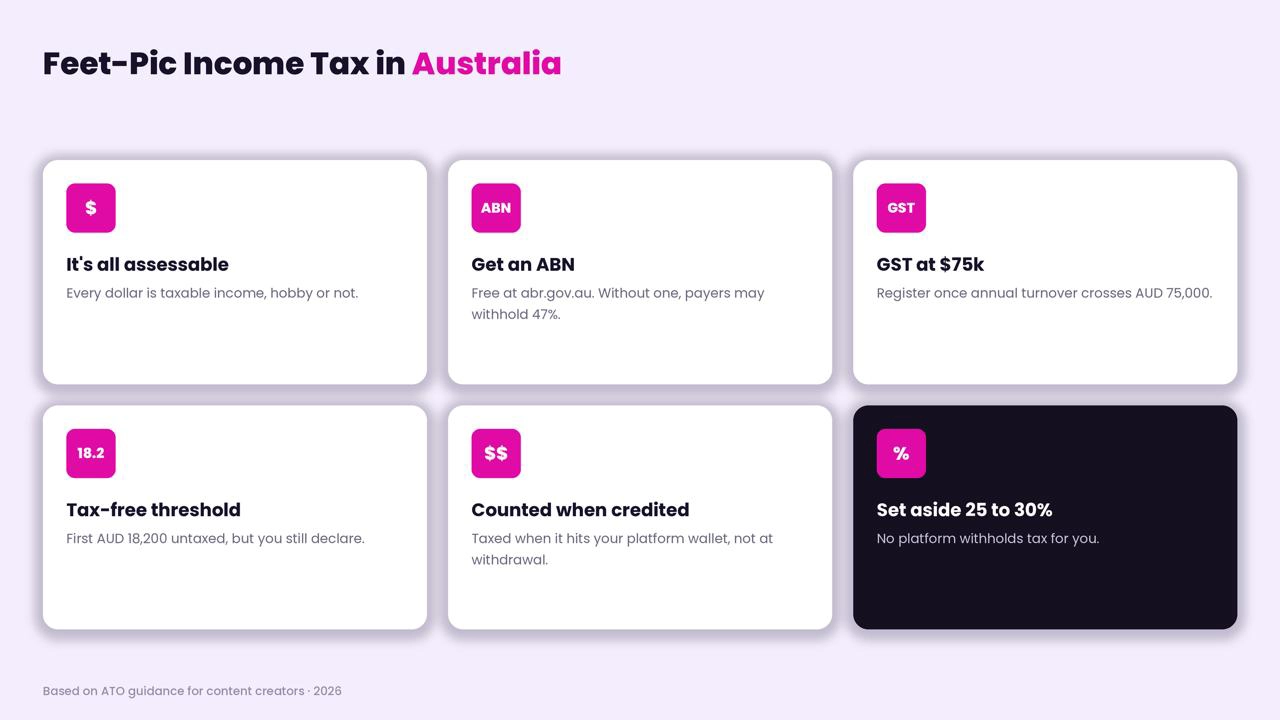
All of it is assessable income.
The ATO treats money from selling feet content the same as money from a job. It does not matter whether you consider it a hobby or a business, whether you earn $500 or $50,000, or whether the buyer is in Sydney or Los Angeles.
Subscriptions, tips, pay-per-view unlocks, and custom orders are all assessable. Australia taxes residents on worldwide income, so overseas buyers do not change anything.
The ATO already sees platform earnings.
Since 1 July 2024, the Sharing Economy Reporting Regime (SERR) requires electronic distribution platforms to report Australian creator earnings directly to the ATO twice a year, by 31 January for July to December and by 31 July for January to June.
On top of that, the ATO runs bank data-matching on international transfers.
The practical result: if your tax return says nothing and your bank shows regular international deposits, you are a likely audit target. Undeclared creator income is not a quiet corner of the internet anymore.
Income counts when it hits your platform wallet, not when you withdraw.
The ATO's position is that you have earned the money as soon as it is credited to your account on the platform. Leaving a balance sitting there does not defer the tax.
You will probably need an ABN.
If you are selling regularly and operating like a business (posting, promoting, taking customs), that is a business activity, and you register for an Australian Business Number.
It is free, takes about 10 minutes at abr.gov.au, and links to your tax file number. Skipping it has a real cost: without an ABN, some payers are required to withhold 47 percent of what they pay you.
GST kicks in at $75,000.
If your annual turnover crosses AUD $75,000, you must register for GST and account for it. Income from overseas subscribers may be GST-free, but it still counts toward the $75,000 threshold, which catches a lot of creators off guard. Below the threshold, you do not charge GST, but you still declare all income.
The tax-free threshold is $18,200, and you still have to lodge.
Earn under $18,200 across all sources and you will not pay income tax on it, but you still declare the income and may still need an ABN and records.
Above that, your creator income is added to any other income and taxed at your marginal rate, plus the 2 percent Medicare levy.
Set money aside from day one.
A sensible starting point is putting away 25 to 30 percent of every payout for tax.
OnlyFans, FeetFinder, and every other platform withhold nothing on your behalf. The tax is entirely your responsibility, and the bill lands at once if you have not planned for it.
Claim your deductions.
Running this as a business means legitimate expenses reduce your taxable income: the business-use portion of your phone, internet, and camera gear, lighting, props, pedicures where genuinely tied to content, platform subscription fees, and payment or currency-conversion costs.
Every deduction has to be directly connected to earning the income, and mixed-use items can only be claimed for the business-use share. Keep receipts and records.
Cloud accounting software connected to a dedicated business bank account turns tax time from a scramble into a 10-minute job.
Superannuation is optional but smart.
As a sole trader you are not required to pay yourself super, but contributing is worth considering for the long-term and can carry tax benefits.
Two honest caveats. First, this is general information, not personal tax advice. Your situation may differ, and a registered tax agent or accountant is worth the fee once you are earning steadily. Second, the rules genuinely tightened, and creators who treated 2022-era "no one will notice" advice as current have been caught out. Do it properly from the start.
Getting Paid in Australia
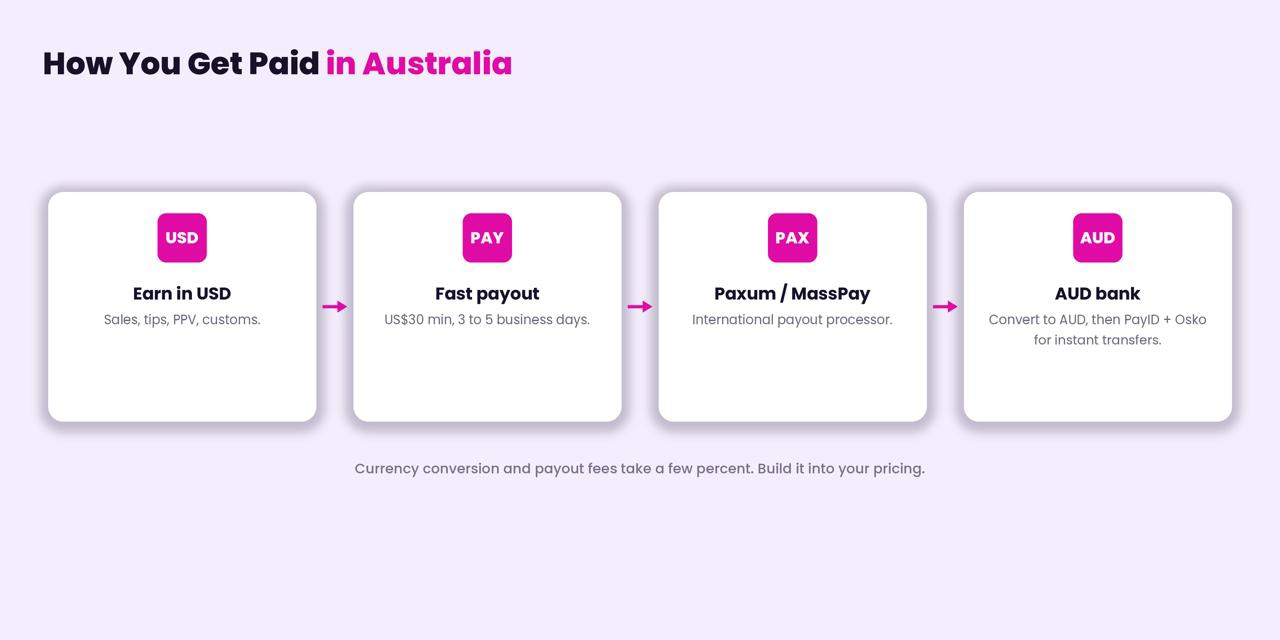
The mechanics of getting money into an Australian bank account trip people up more than the earning does.
Your earnings arrive in US dollars.
FeetFinder and most competitors price and pay in USD. As an Australian creator, you are converting USD to AUD at some point, and the exchange rate moves.
If the Australian dollar weakens between when you earn and when you withdraw, the extra AUD you receive is itself assessable income. If it strengthens, the shortfall can be a deductible loss. Track it.
International payouts run through Paxum or MassPay.
FeetFinder pays US sellers to their bank through an integrated processor, and pays international sellers, including Australians, through Paxum or MassPay.
Paxum is the adult-industry-standard payout processor. You receive funds into your Paxum account, then withdraw to your Australian bank. On FeetFinder you request a payout once your balance reaches the US$30 minimum, and it is typically released within about 3 to 5 business days.
Domestic transfers use PayID and Osko.
Once money reaches your Australian bank, moving it around domestically is instant through PayID and Osko. That part is easy. The friction is entirely in the international leg and the currency conversion.
Keep a separate business bank account.
Do not mix creator income with personal spending. A dedicated account in your trading name makes record-keeping dramatically easier, keeps deposits from appearing under your personal name, and is close to essential if the ATO ever reviews your affairs.
Some creators go further and operate through a company so the company name, not their personal name, appears on the ABN register and other public records. That is a call to make with an accountant based on your income level and privacy needs.
Budget for the friction. Between currency conversion and payout processing, a few percent of your gross disappears before it reaches your AUD balance.
It is a normal cost of an international platform, but factor it into your pricing rather than being surprised by it.
Where to Sell Feet Pics in Australia in 2026
There is no single best platform for every creator.
The right pick depends on whether you already have a following, how much you value built-in buyers, and how you want to get paid.
Here is an honest comparison of the main options for an Australian seller, current to mid-2026.
Verify fees and payout rules during signup, because platforms change them.
|
Platform |
Seller cost (2026) |
Payout for AU creators |
Buyer discovery |
Best for |
|---|---|---|---|---|
|
Seller subscription ($4.99/mo or $14.99/yr, other terms available) plus a service fee on sales. You keep 90 percent on Premium or 85 percent on Basic (a 10 or 15 percent fee). Buyers pay nothing extra. |
US$30 minimum, released within about 3 to 5 business days of a request; international via Paxum or MassPay. |
Strong. Largest verified feet-only buyer base, plus search and category browsing. |
Creators who want built-in buyers and on-platform payments without an existing following. |
|
|
Mandatory creator subscription (about $9.99/mo) plus a 10 percent commission on sales. |
Twice monthly, on the 1st and 15th, historically via PayPal. Venmo is US-only, so options are thin for Australians. |
Weak. Private subscriber-only profiles, no algorithmic discovery, and slow approval (roughly 1 to 3 weeks). |
Creators who already have a following to import and want private, subscription-only galleries. |
|
|
About $4.99/mo creator fee plus a 20 percent commission. Effective cost can reach 24 to 40 percent once volume is low. |
Bank transfer, PayPal, and crypto; fast payouts. |
Weak. Smaller buyer base, community-style layout. |
Creators who already bring an audience and like a forum-style vibe. |
|
|
No seller subscription; flat 20 percent commission (you keep 80 percent). |
Bank transfer; reports AU earnings to the ATO under SERR. |
None for feet specifically. Your content competes with everything on the platform. |
Creators building a broad subscription brand, not feet-only. |
|
|
Fansly |
No mandatory monthly fee; commission on sales (verify current rate). |
Bank transfer for international; verify at signup. |
Moderate, niche-flexible; you still bring most traffic. |
Creators wanting tiered subscriptions across mixed content. |
A few notes the table cannot hold. A low headline commission can be misleading: Instafeet's 10 percent looks cheap until you add its mandatory monthly subscription and a PayPal-based payout that suits US creators far better than Australian ones. Read the current terms rather than an old blog post, because platforms change fees and payout methods regularly. Free social platforms (Reddit, X, Instagram) are free to post on but leave you handling payments, screening, chargebacks, and scams yourself, which is why most serious sellers use social media for promotion and a dedicated marketplace for the actual transaction. And a smaller commission matters less than it looks if the platform sends you no buyers.
Why Creators Pick FeetFinder
FeetFinder is a US-based marketplace built specifically for feet content. The idea started in 2019 with founder Patrick Nielson, and the platform has grown into one of the largest verified feet-only marketplaces.
It is not an Australian company, and it does not have Australia-specific features like local sizing filters. What it offers an Australian seller is more useful than novelty features: buyers, verification, and on-platform payments.
The case for it, stated plainly:
Built-in buyers.
This is the real differentiator. On FeetFinder, people are already searching for feet content, so you are not competing with every other content type the way you would on a general platform.
Creators who earn well on commission-free competitors are almost always importing their own traffic. FeetFinder generates a meaningful share of buyer demand itself, which matters most for creators without an existing following.
Verification and trust.
Every seller proves they are an adult through government ID and identity verification before approval. That verification cuts both ways: it keeps the platform clean and it signals to buyers that the marketplace is legitimate, which supports pricing.
On-platform payments and messaging.
Payments, custom-content requests, and buyer messaging stay inside the platform, using PCI-compliant payment processing.
Keeping transactions on-platform is one of the single most important safety practices in this business, because it gives you records and protection that off-platform DMs never will.
Now the honest counterweight, because pretending a product has no downsides is not our style.
FeetFinder charges a seller subscription whether or not you sell that month, so there is a fixed cost to clear before you are ahead.
Do the break-even math: the subscription is easily recovered by a sale or two in an active month, but in a zero-sale month it is money out with nothing in.
New sellers who paid for a few billing cycles before setting up their profile properly are the ones who feel this. The lesson is not to avoid the platform, it is to build your profile, shoot your content, and start promoting before you count on the subscription paying for itself.
You can read unfiltered creator experiences on the is FeetFinder legit site, and the mechanics of the platform are laid out in how the FeetFinder platform works.
Step by Step: Start Selling From Australia
The setup itself takes an afternoon. Verification usually clears in 24 to 72 hours.
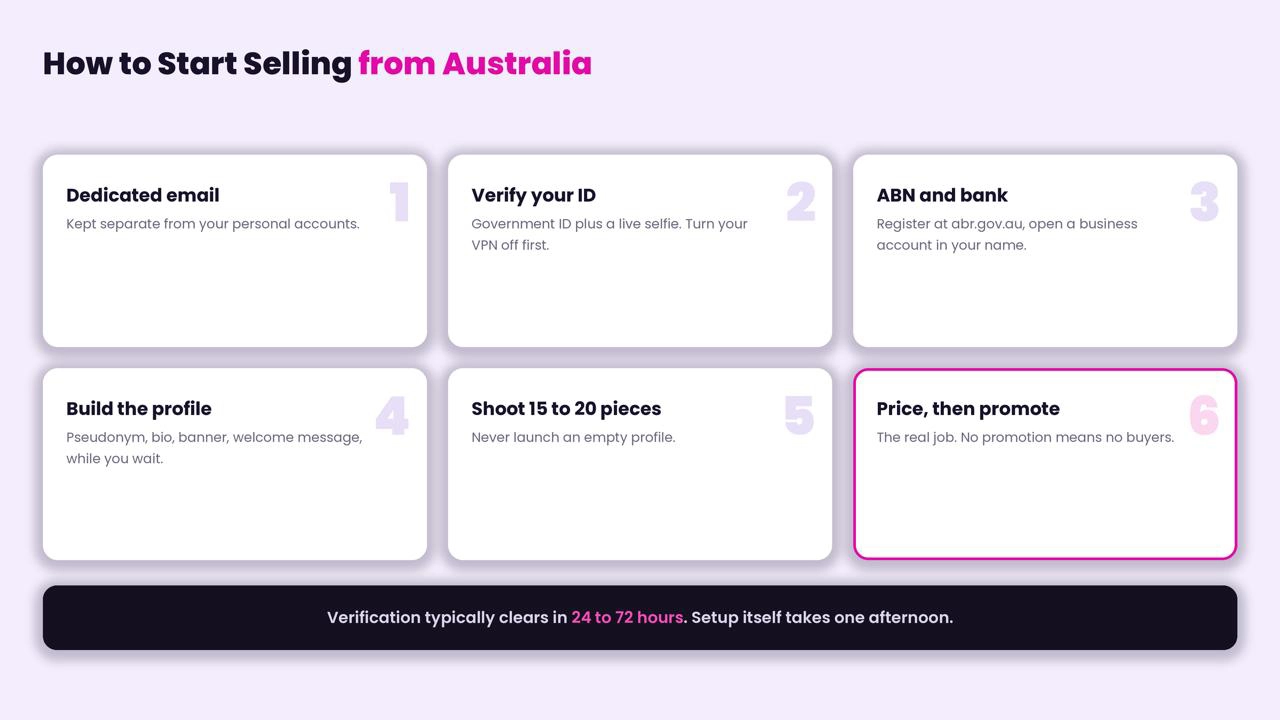
Here is the order that saves you time and money.
1. Create a dedicated email.
Keep it separate from your personal accounts. This one boundary protects your privacy more than almost anything else you will do.
2. Verify your identity with your VPN off.
You will submit a government photo ID (passport, driver licence, or other accepted ID) and, on most platforms, a live selfie. Turn any VPN off first, because a location mismatch is a common cause of verification delays.
3. Sort your ABN and a business bank account.
Register your ABN at abr.gov.au before the money starts. Open a separate bank account in your trading name for creator income. Doing this now, rather than at your first tax return, saves a genuine headache later.
4. Build the profile while you wait for approval.
Choose a pseudonym you are happy to be known by, write a clear bio, add a banner, and set up a welcome message. Do this during the verification window so you are ready to go live the moment you are approved.
5. Shoot 15 to 20 pieces before you launch.
Never open an empty profile. Buyers who land on a bare page leave immediately. Shoot a starter library across a few looks and settings so there is something to buy on day one.
6. Price, then promote.
This is the actual job. A verified profile with content still needs buyers, and on most platforms that means promotion. This is the step where most new sellers stall, so treat it as the real work, not an afterthought.
Pricing Your Content
Forget the old advice that told you to charge $75 to $90 per photo. That was fiction, and it will price you out of a sale.
Realistic 2026 pricing for individual photos sits in the range of roughly $5 to $30 each, depending on quality, niche, and your following.
For a reference point, FeetFinder's own figure puts the average photo sale around $18, which is enough to recover an annual seller subscription in a single sale.
Bundles are where the value is for both sides: a set priced as "10 photos for $40" gives the buyer a discount and gives you a larger single sale. Video generally commands more than stills.
Customs, where a buyer requests specific poses or settings, are your highest-value work and can carry a premium, because the buyer is paying for exactly what they want and cannot get it elsewhere.
A few pricing principles that hold up:
-
Start slightly higher than the floor, then run promotions. You can always discount; it is harder to raise prices on an existing buyer. Time-limited sales and first-subscriber discounts convert well without permanently devaluing your work.
-
Bundle to raise average order value. Multi-packs and set pricing consistently outperform selling one photo at a time.
-
Reserve your best work for customs and premium tiers. Give buyers a reason to spend more, not just more of the same at the same price.
-
Refresh regularly. New content gives existing buyers a reason to come back. A profile that never updates goes stale fast.
Remember the currency layer. Your prices are set in USD and you receive AUD after conversion, so build the few percent you lose to FX and payout processing into your pricing rather than absorbing it.
Staying Safe and Anonymous
You do not need to show your face to sell feet content, and most successful sellers never do. Anonymity is a workflow, not a single setting. Here is the workflow.
Use a pseudonym and keep identities separate.
Your creator persona, dedicated email, and business banking should not connect back to your personal identity. Be careful about identifying features in shots, including distinctive tattoos, jewellery, or recognisable backgrounds.
Watermark your preview images.
Any teaser you post publicly for promotion should be watermarked. It discourages theft and reuse of content you have not been paid for.
Keep payments and conversation on-platform.
The most common scam pattern is a "buyer" who wants to move you off the platform to pay through some other method, or who asks for content before paying.
On-platform payment exists to protect you, with records and dispute handling that private channels do not offer.
A buyer pushing you off-platform is a red flag, not a bigger opportunity.
For the full set of scam patterns to watch for, see how to avoid the most common feet-pic scams.
Know your recourse.
If content is ever shared without your consent, Australia's image-based abuse scheme through eSafety lets you seek removal, and platforms must act on a removal notice within 24 hours. You are not without options if something goes wrong.
Mind the rules on your promo channels. Australia's social media minimum-age framework, in force since December 2025, keeps under-16s off certain social platforms, which is part of why you keep promotion strictly adult and clearly labelled.
Promotion accounts also get reported and suspended by other users from time to time, which is a platform moderation action rather than a legal problem, so keep backups of your content and do not depend on a single promo account.
Promoting Your Profile
A marketplace profile is a destination. Traffic is your job. The creators who earn the most treat promotion as the core work, not an add-on.
Build separate, anonymous accounts to promote on Reddit, Instagram, and X.
Post watermarked previews with relevant tags, engage genuinely in feet-content communities rather than only dropping links, and drive interested people to your marketplace profile.
Never link your promotion accounts to your personal social media. Collaborating with other sellers, cross-promoting, and offering bundle deals can extend your reach without extra content cost.
The uncomfortable truth from the earnings data: promotion is the difference between the sellers making $100 a month and the ones making four figures.
The platform can convert traffic. In most cases, it cannot generate all of it for you.
The Balanced Verdict
Selling feet pics from Australia in 2026 is legal, viable, and considerably more regulated on the tax side than it used to be.
It is a real side income for people who treat it like a small business, and a waste of a subscription fee for people who expect it to run itself.
It is a good fit if you are 18 or over, comfortable handling your own tax and ABN, willing to do consistent promotion, and looking for a repeatable side income rather than an overnight windfall.
FeetFinder suits this profile well because it brings buyers and handles payments, which lowers the promotion burden for people without an existing audience.
It is a poor fit if you are unwilling to declare income, expecting large money in the first month, or unwilling to promote. No platform fixes those.
The honest headline: modest, achievable income for steady effort, real tax obligations, and a payment setup that needs a little patience. Go in with clear eyes and it works. Go in believing the old hype and it will not.
Frequently Asked Questions
Is it legal to sell feet pics in Australia?
Yes, for adults 18 or over selling non-obscene content. There is no law against it. The Online Safety Act 2021 regulates the platforms that host adult content, and ordinary tax law applies to your earnings.
Do I have to pay tax on feet-pic income in Australia?
Yes. The ATO treats it as assessable income regardless of amount, and since 1 July 2024 platforms report Australian creator earnings directly to the ATO under the Sharing Economy Reporting Regime. Declare everything and set aside roughly 25 to 30 percent for tax.
Do I need an ABN to sell feet pics?
If you are selling regularly and operating like a business, yes. An ABN is free and takes about 10 minutes at abr.gov.au. Without one, some payers must withhold 47 percent of what they pay you.
When do I have to register for GST?
When your annual turnover crosses AUD $75,000. Overseas income may be GST-free but still counts toward that threshold.
Do I have to show my face to sell feet pics?
No. Most sellers work anonymously, showing only their feet and using a pseudonym, a dedicated email, and separate business banking. Age verification uses your ID privately and is not shared with buyers.
How much can I realistically earn?
There is no reliable universal average. New sellers commonly report $100 to $500 in their first month, with a smaller group of established, well-promoted creators earning four figures monthly. Your results depend on quality, pricing, consistency, and promotion.
How do I get paid in Australia?
Earnings are in US dollars. FeetFinder pays international creators through Paxum or MassPay once you reach a US$30 minimum, typically within about 3 to 5 business days of requesting a payout. You then withdraw to your Australian bank and convert to AUD, so budget for currency conversion.
Is FeetFinder safe to use?
It uses government-ID verification for every seller, PCI-compliant payment processing, and keeps payments and messaging on-platform. The main practical caution is the seller subscription, which you pay whether or not you sell that month, so set up your profile and start promoting before relying on it.
Disclosure: This article is editorial and not legal or tax advice. Tax and online-safety rules change and depend on your circumstances. Consult a registered tax agent, accountant, or qualified lawyer for advice on your specific situation.
Reviewed & written by
Zireva Knoxe
Zireva Knox reviews creator platforms for FeetFinder, focusing on the details that matter most to sellers, including payout reliability, platform fees, chargeback protection, and content ownership. She carefully evaluates each platform beyond its marketing claims, helping creators understand the real experience before they invest their time, money, or content. Her reviews are practical, transparent, and based on thorough research.