How to Sell Feet Pics Without Getting Scammed in 2026
Transparency Note: This article is published by FeetFinder. For this update, we checked FeetFinder's current Seller Agreement, Terms of Service and Age Verification Policy along with current FTC and FBI guidance on online fraud. No marketplace can remove every risk, and we have avoided using unpublished scam statistics or guarantees about seller safety.
Quick Answer: If you want to sell feet pics without getting scammed, keep the sale, payment and delivery process on the marketplace you are using.
For FeetFinder sellers, this is also part of the platform rules. Buyers must use approved payment methods through FeetFinder's billing interface, and sellers must not use third-party payment providers to accept payment for Seller Offerings.
Few habits prevent many avoidable problems: confirm a purchase inside your account instead of trusting screenshots, never pay a buyer a fee to receive money, never send a buyer your government ID or banking login, be careful with links sent through messages, and keep your personal identity separate from your public creator profile.
Key Takeaways
- Watch what a buyer asks you to do, not whether their profile looks real. A convincing profile can still belong to a scammer.
- Almost every scam tries to move you off your normal process: off-platform payment, a screenshot instead of a real transaction, or an advance fee.
- Never pay a buyer, never send your ID to a buyer, and never log in through a link a buyer sends you.
- Confirm every purchase inside your own account, and put custom orders in writing before you create them.
- If something goes wrong, stop, save evidence, report the account, and contact your bank or the relevant authority using official channels.
If you are still learning the entire seller process, start with our FeetFinder Master Guide.
Why Feet Pic Scams Can Look Genuine At First
Most obvious scams are easy to ignore. The difficult ones begin like normal buyer conversations. Someone might ask "how much do you charge?" or "do you make custom sets?" There is nothing suspicious about those questions.
The problem often starts when the person asks you to change the normal transaction process. Maybe they want your Cash App instead of using the marketplace. Maybe they send a screenshot claiming they already paid. Maybe they ask for a free picture "just to verify quality."
That is why it is usually more useful to watch what the person asks you to do than to judge whether their profile looks real. A convincing profile can still belong to a scammer, and a basic-looking account can belong to a real buyer.
8 Feet Pic Scams Sellers Should Know
1. The Free Sample Request
A buyer says they are interested in purchasing a large set but first wants a free picture. Typical messages include "send me one sample first and I'll order the full package" or "I need to know you're genuine before I pay."
Sending one image might not seem like a big deal, but there is no reason to repeatedly provide content that you intended to sell. If your marketplace allows previews, use those. You can also create limited preview material that does not give away the full product.
What to do: Do not allow the promise of a bigger future order to pressure you into sending content you would normally charge for. If pricing is what you are unsure about, our guide to how much feet pics sell for explains the difference between listing prices, completed sales and actual seller take-home.
2. The Off-Platform Payment Request
A buyer might suddenly ask "can I pay you on Venmo?" or "what's your PayPal?" or "do you take Zelle?" The important point is not that those services themselves are fake. The issue is that you are now being asked to move the transaction outside the marketplace you chose to sell through.
FeetFinder's current Seller Agreement says Buyers must submit payments using approved methods through the website's billing interface. Sellers must not use third-party payment providers, including services such as PayPal, Venmo or Zelle, to accept payment for Seller Offerings.
What to do: If the content is being sold through FeetFinder, keep the payment there. A genuine buyer who wants your FeetFinder content can use the payment options available through the platform.
3. The Fake Payment Screenshot
This one works because it creates urgency. A buyer sends a screenshot that appears to show "Payment sent: $100," then asks you to deliver immediately. A screenshot is not proof that the transaction is actually recorded in your account.
FeetFinder's Seller Agreement says that once the seller receives confirmation from FeetFinder that the Buyer/Seller Transaction has been confirmed, the seller should perform their part of that transaction.
What to do: Open your account yourself and verify the transaction there before providing the paid content. Do not rely solely on screenshots, forwarded emails, images of bank transfers, a buyer saying payment is "pending," or messages claiming a payment will release after delivery.
4. The Overpayment Trick
A stranger tells you they accidentally paid much more than agreed. For example: "I meant to send $50 but sent $500. Can you return $450?" They may create fake payment evidence or use a payment that can later fail or be reversed. The money you send back, however, may be very real.
What to do: Do not privately refund money to a buyer simply because they claim to have overpaid. If there is an actual problem with a FeetFinder transaction, use the applicable platform support and payment process instead of creating a second transaction with the buyer.
5. The "Pay A Fee Before I Can Pay You" Scam
This is usually easy to recognize once you know the pattern. The person promises to buy your content but claims you must first pay a verification fee, processing fee, account upgrade, business-account charge, payment release fee, or transaction unlocking charge.
Think about what is happening. You are the seller. An unknown buyer should not require you to send them money before they can purchase your content. Legitimate platform fees are disclosed by the actual platform, not invented inside a buyer conversation.
What to do: Do not send money to a buyer to "unlock" their payment.
6. Gift Card Payments
Someone might offer Amazon, Apple, Google Play, Steam or another gift card instead of a normal purchase. An even bigger red flag is when they ask you to buy a gift card and give them the card number or PIN. FTC guidance treats requests to buy gift cards and provide the codes as a common scam pattern.
What to do: Do not use gift cards as a substitute for the marketplace payment process. And never purchase a gift card because a buyer says it is needed to verify, release or refund a payment.
7. Fake Feetfinder Or Payment Links
This scam can be much harder to notice because the page may look professional. A message says something like "your payment is on hold, verify here" or "FeetFinder needs you to confirm your account."
The link may lead to a page designed to imitate a marketplace, email provider or bank login. Modern phishing pages can reproduce brand colors, logos and login screens very convincingly.
What to do: Do not log in through an unexpected link sent by a buyer. Open FeetFinder yourself by going to the site normally.
Do the same with your bank, email provider, payout service and payment account. If there really is an account problem, you should be able to see it after signing in through the genuine website.
8. Personal Information And Id Requests
A buyer does not need your government ID to purchase your feet content. They also do not need your home address, surname, employer, school, bank login, identity documents or daily routine.
FeetFinder already requires sellers to complete private identity and age verification. Its current policy says that verification may include a valid government-issued photo ID and a selfie or biometric match where permitted. That verification is between you, the platform and its approved verification process. It is not something you need to repeat for every buyer.
Payments Built In
Sell where the payment process is built in
Approved payments, private verification, and defined transaction rules. Keep every sale on-platform.
Keep Your Real Identity Separate From Your Seller Profile
Privacy and scam prevention overlap. You can have a public creator identity while still completing private verification. Before uploading a photo, check more than your face.
Look for mail in the background, mirrors, house numbers, work badges, car plates, family photographs, recognizable local landmarks, documents, and reflections in windows or screens.
A creator username can also help separate your seller profile from personal social accounts. If you want to build that separation properly, these two guides are useful: how to sell feet pictures anonymously and FeetFinder Username Ideas.
Do not reuse a very distinctive username from your personal Instagram, TikTok or another public account if anonymity matters to you.
Be Clear About Custom Content Before You Make It
Custom orders create a different kind of risk because the buyer is paying for something that has not yet been created. Vague instructions cause problems. Instead of agreeing to "make me something good for $50," confirm the actual request. For example:
Custom order
10 photos · black heels · indoor background · soles included · face excluded · agreed price: $XX · delivery through FeetFinder
This also makes it easier for you to decide whether the request is within your boundaries. Your public bio can help set expectations before the conversation even starts.
For ideas, see our FeetFinder Bio Ideas. A good seller bio does not need to explain your entire life. It should tell buyers what you offer and, where useful, what types of requests you do not accept.
How Feetfinder Payments Actually Work
This part deserves clarification because many online scam guides loosely call every marketplace payment system "escrow." FeetFinder's current legal documents do not describe ordinary digital-content transactions as traditional escrow where money is held until both buyer and seller manually confirm delivery.
Instead, the Seller Agreement says Buyer Payments are received by approved third-party payment providers. FeetFinder deducts its applicable service fee and holds the Seller Earnings on the seller's behalf before paying them under its payout procedures.
The current Terms also state that Seller Earnings can be subject to a 30-day review period before payout to account for potential chargebacks, payment reversals or fraudulent transactions. That is the wording sellers should plan around.
So what does the platform provide? Buyer Payments are received and processed by approved third-party payment providers. All sellers complete identity and age verification. The Buyer-Seller Agreement sets out terms governing purchases and the license buyers receive to access paid content.
And sellers cannot redirect payment for Seller Offerings to an unauthorized third-party provider. None of this means there is zero possibility of fraud. It means the transaction follows a defined process instead of being an informal arrangement between two strangers.
7 Rules For Selling Feet Pics More Safely
You do not need a complicated fraud-detection system. A consistent routine is more useful.
1. Use a dedicated marketplace. Social media can be useful for discovery, but payment, content delivery and transaction records are easier to manage when the sale happens through a dedicated marketplace. For the complete account and listing workflow, use our guide to selling feet pics on FeetFinder.
2. Protect your public identity. Complete the verification your marketplace requires, but do not give unknown buyers more personal information than they need. Keep your offline life and seller profile separate where possible.
3. Keep the payment where the sale happens. If you are selling through FeetFinder, use FeetFinder's approved payment process. Do not allow every new buyer to choose a different payment method.
4. Check the transaction yourself. A buyer telling you they paid is not the same as your account showing a confirmed transaction. Open the platform and check.
5. Confirm custom requests in writing. Price, quantity and requirements should be clear before you create the content.
6. Be careful with unexpected links. Do not access sensitive accounts from URLs sent by strangers. Navigate to the service yourself.
7. Keep useful records. For suspicious situations, save usernames, screenshots, relevant messages, dates, transaction IDs and links. For ordinary business records, also keep information about your income, platform fees and payouts. Our FeetFinder taxes guide explains the tax-record side in more detail.
Quick Feet Pic Scam Checklist
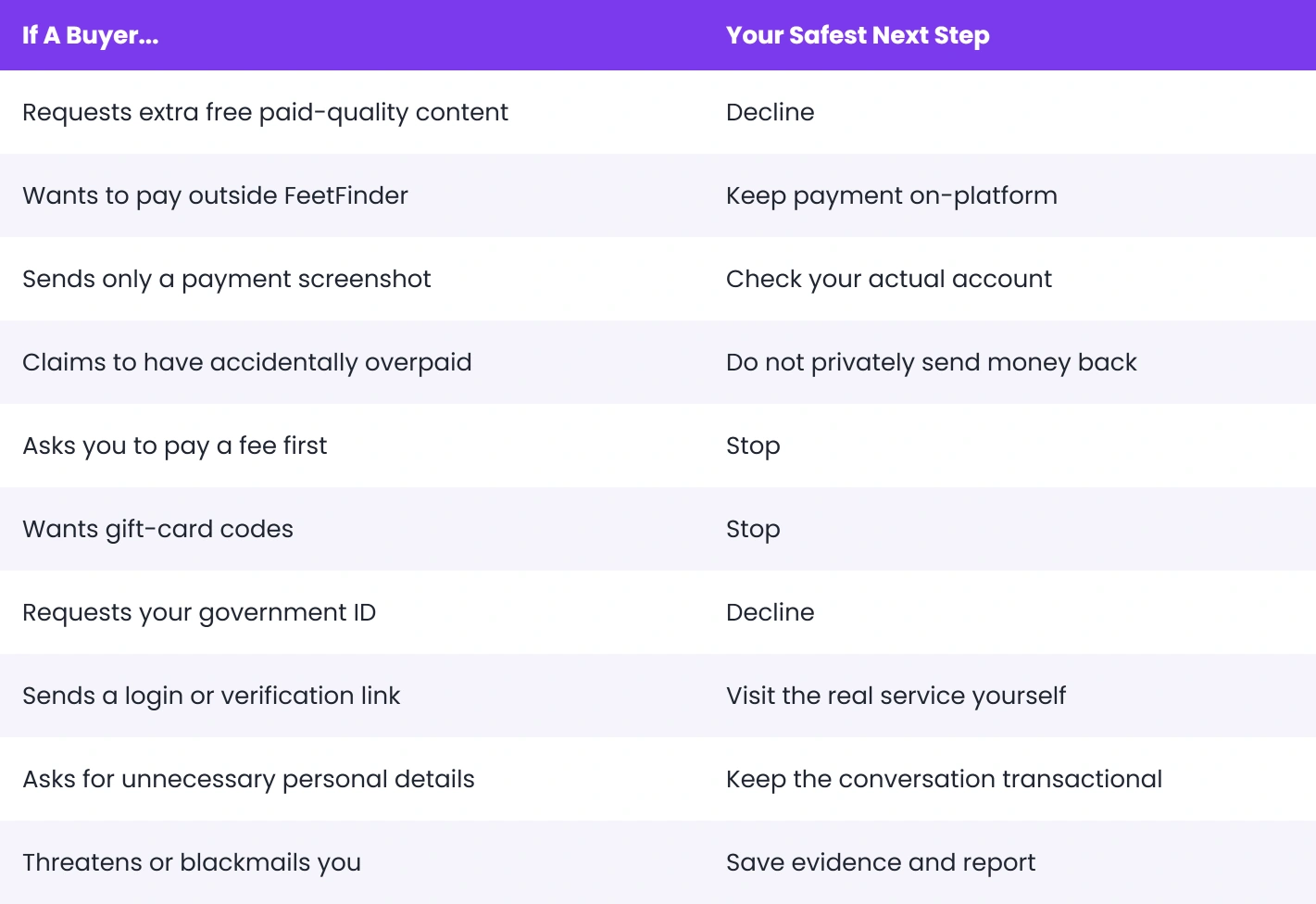
You do not owe a suspicious buyer a long explanation. Sometimes the easiest response is to end the conversation.
Can Instagram Or Reddit Be Used Safely?
Instagram and Reddit can be useful places to build an audience or let people discover your creator profile. The risk increases when a casual DM becomes an independent sale.
Now you have to decide how payment is made, whether the payment is genuine, how content is delivered, what happens after a dispute, and how much personal information the other person sees.
A cleaner approach is to use social media for discovery and direct interested buyers to the marketplace where you actually sell.
That does not mean every Instagram or Reddit buyer is a scammer. It simply avoids rebuilding your payment and transaction process for every stranger who sends you a DM.
Is Feetfinder A Scam?
FeetFinder is an operating marketplace with published Terms of Service, a Seller Agreement, a Buyer-Seller Agreement, age-verification rules, payment rules and seller payout procedures.
That is separate from the question of whether an individual user can attempt to scam another person. A legitimate marketplace can still have users who behave dishonestly.
A more useful way to evaluate a marketplace is to look at how payments are processed, what verification exists, what the terms say, whether transactions have defined rules, and what happens when a payment is reversed or disputed.
For marketplace-specific feedback, you can also read FeetFinder's reviews separately rather than relying only on scam-related search results.
What Should You Do If You Have Already Been Scammed?
First, stop sending additional money or content. Do not let the other person convince you that another payment will "fix" what already happened. Then:
Save the conversation. Take screenshots and preserve usernames, dates, messages, transaction records, links and payment details.
Report the account. If the incident took place on FeetFinder, report the relevant user through the platform's available reporting and support process.
Contact your financial provider if necessary. If a bank card, account or external payment service was involved, contact that provider using official contact information. Do not use a support number or URL supplied by the person who scammed you.
Report significant online fraud. Depending on your jurisdiction and what happened, you may also consider reporting online fraud to the relevant consumer-protection or law-enforcement authority. In the United States, the FBI's Internet Crime Complaint Center accepts reports of internet-enabled crime.
What If Someone Threatens To Expose You?
Threats involving your identity or private content deserve more care than an ordinary payment disagreement. Do not rush into paying someone because they promise "pay me and I'll delete everything."
Save the messages and any evidence of the threat. If the threat involves intimate imagery, extortion, stalking or another crime, consider reporting it to the relevant platform and law-enforcement authority. Do not keep escalating the situation by sending additional personal information or content.
What If Someone Reposts Your Feet Pics?
Buying access to your content does not automatically give a buyer ownership of it. FeetFinder's current Buyer-Seller Agreement says the buyer receives a nontransferable, nonsublicensable and nonexclusive license to access the relevant content, and the transaction does not give the buyer ownership of it.
If your content is reposted elsewhere without permission, the appropriate response can depend on where it appears. Possible routes include the receiving site's abuse or report process, a copyright complaint, a DMCA request where applicable, and FeetFinder support if the issue relates to the platform.
Keep the original files and transaction details because they may help establish ownership and where the content came from.
Ai Is Making Some Scams Look More Professional
A few years ago, an obviously fake profile photo or awkward message could be a clue. That is becoming less useful. Generative AI can now help scammers create realistic profile images, polished messages, fake brand graphics, convincing emails, cloned-looking support pages and synthetic audio.
The practical defense has not changed much. Do not ask "does this person look genuine?" Ask "are they asking me to do something I would normally consider unsafe?" A polished profile asking you to hand over your password is still dangerous. A friendly message asking you to pay a "release fee" is still suspicious. Focus on behavior.
How Safety Fits Into Actually Making Money
Safety should come before revenue optimization. There is little value in increasing sales if you are also giving away content, exposing personal information or accepting risky payment arrangements.
Once you have a reliable selling process, then you can work on pricing, content quality, bundles, profile optimization, repeat buyers and custom offers.
For that stage, see our guide on how to make money selling feet pics. If you specifically want to understand realistic pricing before deciding what to offer, use How Much Do You Get Paid for Feet Pics?
Frequently Asked Questions
How Do I Sell Feet Pics Without Getting Scammed?
Keep transactions on a reputable marketplace, use its approved payment process, confirm transactions inside your account, protect your identity, and avoid unexpected links, advance-fee requests and off-platform payment changes.
How Can I Tell If A Feet Pic Buyer Is Fake?
Be cautious when a buyer asks for free paid-quality content, wants to change the payment method, sends only a payment screenshot, asks you to pay a fee, requests gift cards, sends unexpected login links or asks for personal identification.
Should I Use Cash App Or Venmo For A Feetfinder Sale?
FeetFinder's Seller Agreement says sellers must not use a third-party payment provider to accept payment for Seller Offerings. Buyers must use approved payment methods through the FeetFinder billing interface.
Does Feetfinder Use Escrow?
FeetFinder's current Terms and Seller Agreement describe third-party payment processing, holding Seller Earnings on the seller's behalf, and payout procedures. They do not describe ordinary digital-content transactions as traditional escrow requiring manual confirmation from both parties.
Should I Send Free Samples To A Buyer?
You do not have to provide extra paid-quality content because an unknown buyer says they need it before purchasing. Use available previews or intentionally limited preview content instead.
Can A Buyer See My ID?
Seller identity and age verification is handled privately through FeetFinder and its approved verification process. A buyer does not need you to send them a copy of your government ID.
Can I Sell Feet Pics Anonymously?
You can use a public creator identity rather than making your legal identity part of your seller persona, while still completing the private verification required by the platform. For a deeper privacy guide, read how to sell feet pictures anonymously.
What If I Am A Male Seller?
The same core safety rules apply. Male sellers should still keep payments on-platform, protect personal information, verify purchases and document custom requests. For male-specific seller questions, read How to Sell Feet Pics as a Man.
What Should I Do If A Buyer Sends A Feetfinder Login Link?
Do not log in through it. Open FeetFinder directly yourself and check whether the claimed account problem actually exists.
Is Feetfinder A Scam?
FeetFinder is an operating marketplace with published payment, seller, verification and transaction policies. That does not mean an individual user can never attempt dishonest behavior, so sellers should still follow basic online-safety practices.
Bottom Line
You do not need to memorize every scam that exists online. A handful of habits will take you much further: keep the sale on-platform, check transactions yourself, do not pay buyers, do not send strangers your ID, do not click unexpected login links, put custom orders in writing, protect your public identity, and save evidence when something goes wrong.
Most scams rely on getting you to break your normal process because the buyer creates urgency, promises a large payment, or makes you worried that you will lose the sale. If something feels wrong, you are allowed to walk away. A missed sale is cheaper than losing money, content or personal information.
On-Platform Protection
Keep every sale on-platform and protected
Verify privately, sell under a creator name, and use FeetFinder's approved payment process from day one.
If you are new and want the complete account-to-sale workflow, read the FeetFinder Master Guide. For privacy, read How to Sell Feet Pictures Anonymously. For seller profile optimization, see FeetFinder Bio Ideas and FeetFinder Username Ideas.
For income records and tax considerations, see the FeetFinder Taxes Guide. And once you understand the process and are ready to begin, start selling on FeetFinder.
This article is for adults aged 18 and over and is general safety information, not legal or financial advice. No marketplace can remove every risk. Always follow the laws in your country and FeetFinder's current Terms and policies, and report suspected crime to the appropriate authority.
Reviewed & written by
Trevor
Trevor specializes in creating practical how-to guides for new content creators. His work focuses on profile optimization, attracting buyers, avoiding common mistakes, and understanding platform policies. Rather than relying on marketing claims, he emphas