Is Selling Feet Pics Legal? What the Law Actually Says
Legal Disclaimer: This article is general information about how laws can apply to selling feet pictures. It is not legal, tax, or financial advice and is not a substitute for advice from a qualified professional. Laws vary by country and state and change over time. Before you rely on anything here, confirm the current rules for your situation with a lawyer or tax professional in your jurisdiction, and read FeetFinder's current Terms.
A common worry about selling feet pictures is that the activity may be secretly illegal - or that a seller might only discover a legal problem after accepting money.
The reality is more straightforward, but it still requires some care.
The Short Answer
Generally, yes. Adults can usually sell lawful feet pictures they have the right to distribute.
There is no single worldwide rule, however. The legal position depends on factors such as:
-
The seller's age and legal capacity
-
What the image actually depicts
-
Who appears in the content
-
Consent
-
Copyright ownership
-
The country or state involved
-
Tax obligations
-
Consumer-protection rules
-
The terms of the platform being used
The subject being a foot does not, by itself, determine whether a photograph is legal or illegal.
For FeetFinder specifically, users must be at least 18 or the age of majority in their jurisdiction, whichever is higher, and sellers must complete identity and age verification.
FeetFinder operates a marketplace for foot-related content, so we have a commercial interest in this topic. Some references in this guide point to our own policies or educational resources. Legal and tax statements should be tied to primary sources where practical. This article reflects information reviewed in September 2026 and is for general educational purposes only - not legal or tax advice. Laws differ by jurisdiction and can change.
Is Selling Feet Pics Legal In 2026?
For an adult selling lawful photographs they have the right to distribute, selling feet pictures is generally legal.
The legal issues usually come from broader areas of law rather than from a statute specifically concerned with feet photography.
Depending on the jurisdiction and the circumstances, relevant rules may include:
-
Age restrictions
-
Consent
-
Copyright
-
Privacy
-
Consumer protection
-
Taxation
-
Contracts
-
Sexually explicit or adult-oriented content
-
Fraud and impersonation
-
Platform-specific compliance requirements
That distinction matters.
A better legal question Instead of asking only whether feet pictures are legal, ask: Am I legally entitled to create, distribute and sell this particular content in the way I am doing it?
What Determines Whether Selling Feet Pictures Is Legal?
Several checks matter more than the subject of the photograph itself.
1. Age And Legal Eligibility
Age is one of the most important requirements.
FeetFinder is an adults-only platform. Its current Age Verification Policy requires users to be at least 18 or the applicable higher age of majority to create an account, buy content or act as a seller. Sellers undergo age and identity verification, which may include government-issued photo ID and selfie or biometric matching where permitted.
Other platforms may have different eligibility requirements.
Content Involving Minors Is A Different Legal Issue
Sexually explicit, exploitative or otherwise prohibited content involving minors can trigger extremely serious child-protection laws and criminal penalties.
A seller should never attempt to bypass age rules through:
-
False identification
-
Another person's account
-
Another person's ID
-
False age information
-
Methods intended to defeat verification
FeetFinder specifically prohibits attempts to misrepresent age or circumvent its age-verification process.
2. You Need The Right To Sell The Content
Only upload or sell photographs that you are legally entitled to distribute.
If you took a photograph yourself, you will often own the copyright, although ownership can depend on employment, contracts, commissioned work and other circumstances.
If another person created the photograph, appearing in it does not automatically mean you own the copyright.
Before selling content, make sure you understand:
-
Who created the photograph
-
Who owns the copyright
-
Whether you have permission or a licence
-
Who appears in the image
-
Whether any required consent or release has been obtained
3. Consent Matters When Other People Appear
If another person appears in your content, obtain genuine consent before distributing or selling it.
Consent should not come through threats, pressure, deception, coercion or misrepresentation about how the content will be used.
Depending on the jurisdiction, additional privacy, publicity-right or documentation requirements can also apply.
FeetFinder's current policies require sellers to confirm that other people depicted in seller content meet the applicable adult-age requirements and that appropriate records are maintained. Check the current Seller Agreement before uploading co-authored content.
This is one reason solo content is legally simpler than content involving multiple people.
4. Selling An Image Does Not Automatically Transfer Copyright
There is an important difference between buying access to a photograph and buying the copyright in that photograph.
Under U.S. Copyright law, ownership of a copyright is legally distinct from ownership of the particular copy in which the work appears. Transferring a copy does not, by itself, transfer the copyright.
That means a buyer should not automatically assume they can:
-
Repost the image publicly
-
Resell it
-
Sublicense it
-
Claim ownership
-
Use it commercially
The buyer's rights depend on the applicable licence or agreement. FeetFinder's Buyer-Seller Agreement likewise governs how buyers may access seller content while keeping content ownership and licensing as separate concepts.
5. Selling Feet Pics Can Create Tax Obligations
Making money from lawful content is not normally what makes the transaction illegal. But earning money can create tax obligations.
Tax treatment varies significantly between countries, so there is no universal threshold or form that applies to everyone.
Transparency Note: Important tax point Do not assume that receiving no tax form means your income is automatically tax-free.
For example, the U.S. Internal Revenue Service states that most income is taxable unless specifically exempted and that income should generally still be reported even when no reporting form is received. Income from online sales, freelance work and side jobs can all potentially be taxable.
Depending on where you live, feet-pic income may potentially be treated as self-employment income, business income, casual income or another local tax category.
For platform-specific guidance, see the FeetFinder taxes guide.
Does Fetish Interest Make A Foot Photo Illegal?
No - not by itself.
A photograph does not automatically become unlawful simply because some viewers may find it sexually appealing or fetishistic.
What matters legally is usually what the content actually depicts, its context, how it is distributed and the law that applies.
A non-explicit photograph does not automatically become legally obscene merely because a viewer has a foot fetish.
That distinction is important because fetish content, an adult-oriented platform, sexually explicit content and legal obscenity do not necessarily mean the same thing.
What U.S. Obscenity Law Actually Says
In the United States, the Supreme Court established the modern constitutional obscenity test in Miller v. California.
Broadly, the test asks whether:
the average person applying contemporary community standards would find that the work, taken as a whole, appeals to the prurient interest
the work depicts or describes sexual conduct specifically defined by applicable state law in a patently offensive way
the work, taken as a whole, lacks serious literary, artistic, political or scientific value
An ordinary non-explicit photograph of feet would not ordinarily satisfy that test merely because someone views feet fetishistically.
But Miller is a U.S. Constitutional standard, not a worldwide definition of adult content. Other countries use their own laws and definitions.
Ordinary Feet Photos Vs Adult-Oriented Content
It is better not to say that feet pictures are never adult content. That is too broad.
A more precise distinction is that an ordinary non-explicit foot photograph does not automatically become legally obscene or sexually explicit merely because it appears on an adult-oriented marketplace.
The classification can change depending on:
-
Pose
-
Nudity
-
Accompanying text
-
Sexual context
-
Interaction with buyers
-
Additional body content
-
Local legal definitions
This is why sellers should judge the actual content rather than relying only on the fact that it is a foot photo.
Legal Rules And Platform Rules Are Not The Same Thing
One of the biggest sources of confusion is treating a website's rules as though they were criminal law. They are different.
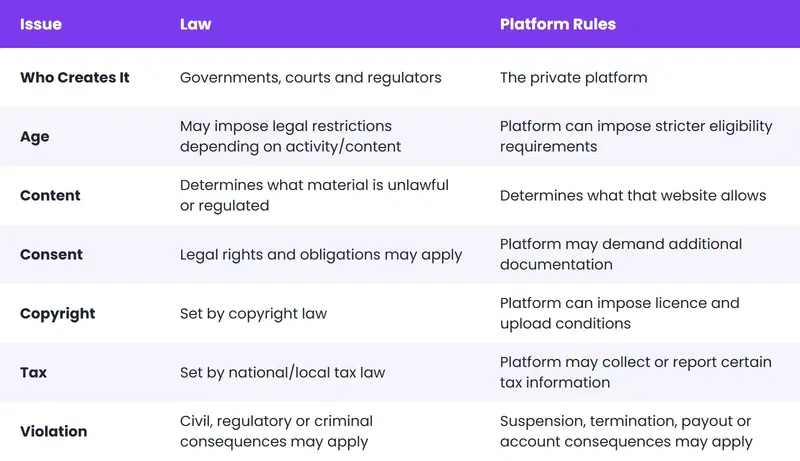
A photograph can therefore be legal to create but not allowed on a particular platform. The reverse also matters: platform approval does not guarantee that a transaction complies with every law applicable to a particular seller.
Why Choosing A Platform Still Matters
Legality and practical safety are separate questions. Even if selling your content is lawful, the selling process can still involve fake buyers, stolen images, payment scams, chargebacks, phishing, impersonation, account takeover attempts and privacy leaks.
Using a dedicated marketplace can reduce some of those risks by providing structured account, payment and verification systems. FeetFinder, for example, requires sellers to complete age and identity verification and operates under platform Terms governing user eligibility, content and transactions.
That does not make scams impossible, nor does it replace the seller's own legal responsibilities.
For practical safety steps, read how to sell feet pics without getting scammed.
Is FeetFinder Legal To Use?
FeetFinder operates an adults-only marketplace.
Its current Terms require users to meet the applicable age requirement, be legally able to enter a binding contract, comply with laws governing adult-oriented material where they live, and not circumvent geographic or age-verification restrictions.
So the better answer to "Is FeetFinder legal?" is: whether a particular person can legally use FeetFinder depends on their age, location, content and applicable laws.
FeetFinder's existence and verification process do not give a seller permission to ignore local law. Likewise, the fact that the platform is adult-oriented does not mean every transaction conducted through it is automatically unlawful.
Can You Use A VPN To Access FeetFinder?
FeetFinder's Terms deserve careful wording here. They do not simply say that every VPN is prohibited.
The Terms prohibit using methods such as VPNs, proxies, false identification or third-party identification to circumvent geographic restrictions or age-verification requirements.
That distinction matters. If FeetFinder is legally unavailable to someone in a particular jurisdiction, hiding their location does not remove the underlying legal restriction.
Does The Law Change By Country Or State?
Yes. This is why no responsible article should claim that selling feet pictures is legal everywhere.
The important issues can vary across jurisdictions, including:
-
Legal age
-
Adult-content restrictions
-
Obscenity laws
-
Privacy
-
Image rights
-
Consent
-
Copyright
-
Consumer protection
-
Tax
-
Business registration
-
VAT/GST/sales-tax obligations
-
Online safety
-
Platform disclosure requirements
Some jurisdictions also impose additional requirements on sexually explicit or adult-oriented online material. Whether those rules apply to a particular feet photograph depends on what the photograph actually depicts and the relevant law.
Country-specific FeetFinder guides can provide local detail for the United States, United Kingdom, Canada, Australia, Mexico and other markets. This master article should remain a general framework rather than pretending to provide a legal opinion for every country.
Do You Need To Show Your Face Or Real Name?
Generally, there is no universal rule requiring every seller of ordinary digital photographs to display their face publicly.
But there is an important distinction between public anonymity and private legal verification.
FeetFinder requires seller identity and age verification. That does not necessarily mean your legal identity must become your public creator identity.
However, using a creator username does not remove tax obligations, verification requirements, business disclosure rules, legal notices or other information that may need to be provided under applicable law.
A seller may be able to keep their legal name separate from their public creator identity while still providing legally required identity information to the platform and other parties where required.
For more privacy guidance, read how to sell feet pictures anonymously.
Can Buyers Purchase The Copyright To Your Feet Pics?
Not automatically.
Unless copyright is separately transferred or licensed more broadly, paying for access to content usually does not mean the buyer owns the underlying intellectual property.
A seller should understand the platform's current licence terms before selling. Likewise, buyers should not assume that purchasing access gives them permission to repost, sell, redistribute, sublicense or commercially exploit the content.
What If Someone Steals Your Feet Pictures?
Unauthorized copying can potentially raise copyright and privacy issues.
Keep:
-
Original files
-
Creation dates
-
Screenshots
-
Transaction records
-
Usernames
-
Copies of listings
-
Other useful evidence
If copyrighted content is reposted without permission, available remedies will depend on the platform, jurisdiction and circumstances. For U.S.-hosted or U.S.-connected services, DMCA procedures may also be relevant in appropriate cases. FeetFinder maintains its own copyright/DMCA process for applicable complaints.
Does Selling Feet Pics Count As Sex Work?
There is no single legal answer that applies everywhere. Different laws, academic definitions, platforms and communities may classify activities differently.
For legal accuracy, it is more useful to ask whether the content is lawful, whether everyone involved is an eligible consenting adult, whether the seller owns or controls the necessary rights, whether the transaction is permitted where it occurs, whether relevant taxes are being handled and whether platform rules are being followed.
Those questions determine compliance more reliably than a label.
Can Social Media Be Used To Sell Feet Pics?
Potentially - but platform rules matter.
Social networks maintain their own policies governing adult content, nudity, sexual solicitation, commercial activity, external payment links and account promotion.
Some platforms restrict certain adult-oriented content or transactions. Do not assume that because the underlying photograph is legal, every social platform must allow you to advertise or sell it.
A platform-policy violation can result in post removal, reach restrictions, account suspension or termination. If the underlying activity separately violates the law, legal consequences may also apply.
Turning A Legal Sale Into A Safer Sale
Once you have determined that the content itself can lawfully be sold, practical risk management becomes the next issue.
Useful precautions include:
-
Keep payments on the approved platform
-
Do not trust screenshots as proof of payment
-
Protect your login credentials
-
Avoid sharing private contact details unnecessarily
-
Keep records of transactions
-
Never send identification to a buyer
-
Check image backgrounds for identifying information
-
Understand the platform's chargeback and complaint procedures
FeetFinder's Seller Agreement also states that sellers must not use third-party payment providers to accept payment for Seller Offerings made through the platform. That is different from saying off-platform payment is universally illegal; it is a platform-contract requirement.
A Practical Legal Compliance Checklist
Age: You meet the applicable legal and platform age requirements.
People in the Content: Anyone else depicted is an eligible consenting adult and any required records or releases have been obtained.
Copyright: You created the photograph or hold the rights needed to distribute it.
Content: The image complies with applicable law and the platform's current content rules.
Listing Accuracy: Your description accurately represents what the buyer is purchasing.
Tax: You are keeping records and understand your local tax obligations.
Privacy: You have checked the image for personal information you did not mean to disclose.
Location: You have considered any local rules applicable to adult-oriented or digital content.
Platform Terms: You have read the current Terms rather than relying on an old blog post or social-media comment.
No amount of clever marketing can fix a serious problem involving age, consent, ownership or unlawful content.
Frequently Asked Questions
Is selling feet pics legal?
Do you have to be 18 to sell feet pics on FeetFinder?
Do you have to pay taxes on money from feet pics?
Can you sell feet pics anonymously?
Can you sell someone else's feet pictures?
Can legal content still violate platform rules?
Is FeetFinder legal to use?
The Bottom Line
Is selling feet pics legal? Generally, yes for adults selling lawful content they have the right to distribute - but there is no single worldwide rule.
The important questions are not really about feet. They are about age, consent, ownership, content, taxes, consumer rules, platform policies and the laws that apply where you live.
A lawful photograph can still violate a website's Terms. Conversely, passing a platform's verification process does not replace your obligation to comply with applicable law.
If you use FeetFinder, review the current Terms, Seller Agreement and Age Verification Policy before selling.
FeetFinder's current Seller Agreement states that the service fee is 15% on the Basic plan and 10% on Premium, leaving eligible seller earnings of 85% on Basic and 90% on Premium, before considering plan costs, taxes, refunds, chargebacks or other individual expenses.
Once you have checked the rules that apply to you, you can sell feet pics online through FeetFinder.
Know The Rules? Here Is The Next Step.
Once you have checked what applies to you, learn how to set up and sell the right way.
Read the FeetFinder Seller Guide →Reviewed & written by
Trevor
Trevor specializes in creating practical how-to guides for new content creators. His work focuses on profile optimization, attracting buyers, avoiding common mistakes, and understanding platform policies. Rather than relying on marketing claims, he emphas
Knock Knock!! Let Your Feet Earn Money
Join thousands of users who are making money by buying and selling feet pictures in a safe, secure platform. Start your journey today with FeetFinder's trusted marketplace.