Fun With Feet Reviews 2026: Should You Sign Up? (Honest, Sourced Review)
Fun With Feet is a real, UK-registered platform (operated by GYCO Online Limited) where sellers pay a subscription to list feet content.
Quick Verdict
It is legitimate, not a scam in the legal sense, and it works well for one specific type of seller: creators who already have an outside audience to send to their page. For everyone else, the picture is harder.
Reviews across Trustpilot and Reddit repeatedly describe the same three problems: almost no organic buyer traffic, a subscription you pay before you earn anything, and, in a number of documented cases, payouts that were delayed or never received.
-
Best for: Established creators with a Reddit, Instagram, TikTok, or X following they can point at the platform.
-
Poor fit for: Beginners expecting the site itself to bring buyers.
Our recommendation: If your goal is actual, reliable sales, start on a larger marketplace with built-in buyer discovery and mandatory two-sided verification. That is FeetFinder — 10M+ verified users, ID and age checks on both buyers and sellers, and weekly payouts. Treat Fun With Feet as an optional second storefront once you already have an audience.
Want buyers, not just a listing?
FeetFinder is a true marketplace with algorithmic discovery, so buyers find you. Every buyer and seller is ID and age verified, checkout is anonymous and PCI-compliant, and payouts run weekly. Over 10 million users and 15M+ pieces of content sold.
If you have been researching how to sell feet pics, Fun With Feet is one of the first names you will meet, usually mentioned in the same breath as FeetFinder and OnlyFans.
The pitch is appealing: an easy sign-up, a low subscription, full anonymity, and a "trusted" feet-only marketplace. Then a lot of sellers pay, upload their content, refresh their dashboard, and watch the number stay at zero.
This review is deliberately different from the ones that just repeat the platform's own marketing. We went through Fun With Feet's own policies, its Trustpilot page, and a long, detailed seller thread on Reddit, and we cross-checked everything against how the platform actually works.
The result is honest: Fun With Feet is not a fraud, and it genuinely suits some people. But it has real, documented limitations you deserve to know about before you spend a penny. We will show you exactly who it works for, who it does not, and what the safer starting point looks like.
How We Reviewed Fun With Feet
We checked Fun With Feet’s public site, seller-facing FAQ and refund policy language, company registration claims, Trustpilot reviews for funwithfeet.co.uk, and public seller discussions (including r/feethustle).
We did not run a paid multi-month controlled earnings test for this article. Platform fees and policies can change—verify on the official site before you pay.
Comparison Table
| Feature | Fun With Feet | FeetFinder |
|---|---|---|
| Model | Closer to storefront (self-traffic) | Marketplace (discovery) |
| Seller Cost | $9.99/month or $14.99/3 months + 15% commission on every sale. | Basic: $4.99/month, $14.99/year, or $40 lifetime + 15% commission. Premium: $14.99/month, $49.99/year, or $80 lifetime + 10% commission. |
| Buyer Discovery | Limited / self-driven (per reviews) | Built-in discovery (marketplace search & categories) |
| Buyer Base (claimed) | ~8,000+ buyers | 10M+ users (claimed) |
| Verification | Seller ID verification (stated) | Buyer + Seller ID/Age verification |
| Payouts | Request withdrawal; payout timing less clearly defined | Weekly payouts (stated) |
| App | Web only | Web platform (verify current mobile app availability) |
| Best For | Creators with an existing audience | New sellers looking for built-in buyer discovery |
What Is Fun With Feet?
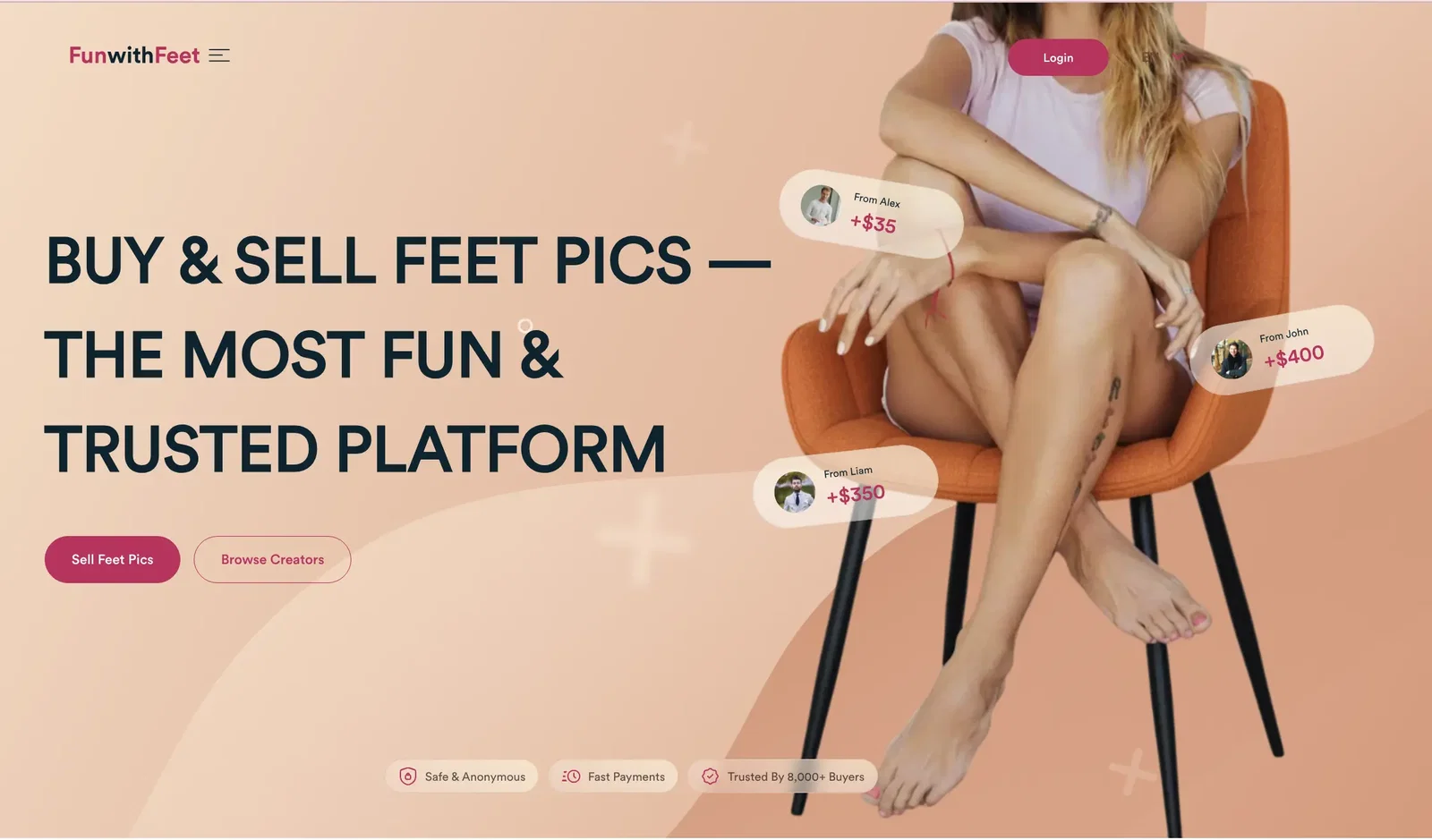
Fun With Feet is an online marketplace, launched around 2021, built specifically for buying and selling photos and videos of feet.
It is operated by GYCO Online Limited, a company registered in England and Wales, with an address at Kemp House, City Road, London.
That UK registration matters for a niche where a lot of platforms are anonymous or offshore, and it is a genuine point in the platform's favour.
The model is simple. Creators sign up, verify their identity, build a profile, upload feet content, and set their own prices.
Buyers browse creator profiles, view free preview content, and pay to unlock full galleries or purchase individual items. Sellers can also accept direct messages from buyers for custom requests, which typically earn more than off-the-shelf content.
The platform markets itself as "the most fun and trusted platform," advertises that it is "trusted by 8,000+ buyers," and keeps content strictly feet-focused, with no general nudity.
A few things stand out immediately. Every creator is ID-verified, which the platform describes as a manual review for quality and authenticity.
Browsing and purchases are designed to be anonymous and discreet.
And the whole experience is niche by design: buyers who are there are there for feet, not scrolling past unrelated content.
If you are wondering about a "Fun With Feet app," there isn't a dedicated mobile app. Everything runs through the website in a browser, which becomes relevant later, because several reviewers describe the mobile web experience as glitchy.
How Does Fun With Feet Work?
From a seller's point of view, getting started takes about an hour, and the flow is genuinely beginner-friendly. You create an account with an email and password, confirm you are 18 or older, and accept the terms.
You choose a subscription plan, because unlike buying, selling is not free. You then verify your identity with a government-issued ID, which the platform is legally required to check.
After verification, you add a payment method for the subscription, set up your bank details for withdrawals, and build your profile with a bio and a profile picture.
From there you upload your content, organise it into galleries, and set your own prices. New sellers commonly price single photos between $5 and $15, with videos and custom work priced higher.
When a buyer purchases, the money lands in your Fun With Feet balance, and you request a withdrawal to your bank.
That last step, the withdrawal, is where the most serious complaints appear, and we will come back to it in detail.
Here is the part the marketing skips: nothing in this flow brings you buyers. You have a shop, but the platform does not send shoppers to it.
That is the difference between a storefront and a marketplace, and it quietly determines whether you make money.
Fun With Feet Pricing and Fees: What You Actually Pay
Fun With Feet charges creators a subscription rather than a per-sale commission.
The most commonly cited pricing is around $9.99 for three months or $14.99 for six months, and some sellers have reported changes to those figures over time.
Buyers pay nothing to join; they only pay for the content they choose to unlock at the prices you set.
On fees, the platform's own seller FAQ is clear: it states that Fun With Feet does not take a commission from seller earnings and that creators keep 100% of what they make.
That is a real advantage on paper compared with platforms that take a percentage of every sale.
You should treat any third-party claim of a fixed commission with caution, because it conflicts with the platform's stated position; the honest summary is that the meaningful cost is the upfront subscription, not a cut of your sales.
And that upfront subscription is the catch. You pay it before you have made a single sale, and, as we cover below, the refund policy specifically does not cover you if the sales never come.
For a beginner with no outside audience, that is money spent on access to a shop with very little foot traffic.
Reader-first takeaway: The commission model is generous, but commission only matters once you are making sales. The real question is whether the platform helps you get those first sales. Fun With Feet's low, no-commission pricing is only a genuine advantage if you can bring your own buyers.
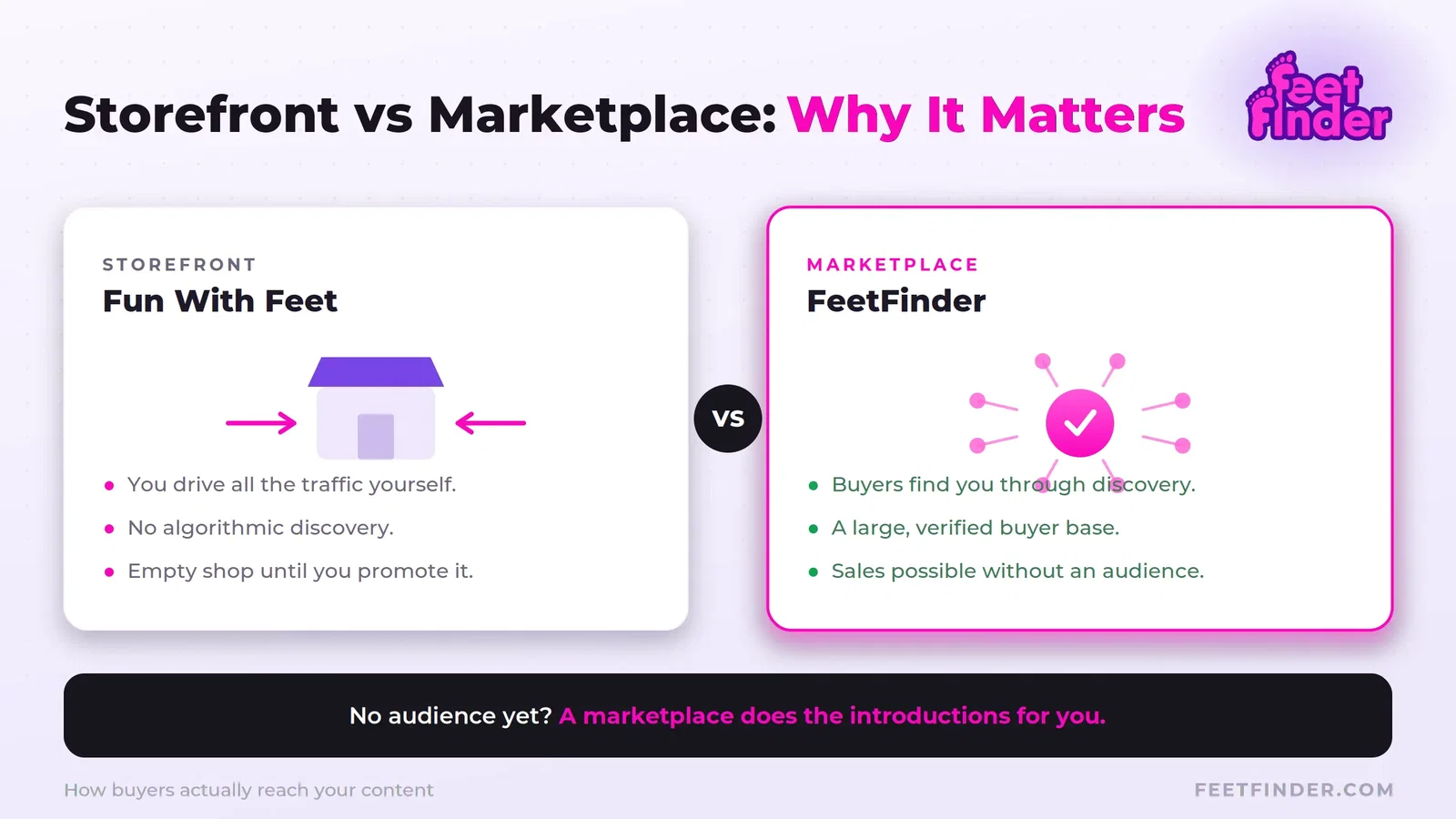
The Core Issue: Storefront vs Marketplace
This is the single most important thing to understand before you choose a platform, and almost no review explains it clearly.
A marketplace actively surfaces sellers to buyers. It has search, categories, rankings, and algorithmic discovery, so a brand-new creator can get views and sales without an existing audience, because the platform does some of the traffic work for you.
FeetFinder works this way, which is why new sellers there report a genuine path to their first sales.
A storefront is just a page that lives on a website. It looks professional, it handles payments, and it keeps you anonymous, but it does not send you shoppers. If nobody knows your page exists, nobody visits it.
Fun With Feet operates much closer to a storefront: you are given the shop, and you are expected to be the marketer who fills it with buyers, usually by promoting your profile on Reddit, Instagram, TikTok, or X.
This is not a criticism of the platform's honesty; it is a description of its architecture. And it explains the most common Fun With Feet experience almost perfectly. A seller uploads content in week one, checks a flat dashboard for a few weeks, and only starts seeing any activity when they begin driving their own traffic from elsewhere.
Sellers often read that silence as "the platform is dead" or "this is a scam," when it is really a mismatch between what they expected and how the platform is built.
If you already have an audience, a storefront is fine, even efficient. If you do not, a storefront is the hardest possible way to start, and a marketplace is what you actually need.
Is Fun With Feet Legit, or a Scam?
Let us answer the exact question people search. No, Fun With Feet is not a scam in the legal sense. It is a real, operating company registered in England and Wales, it processes genuine payments, it verifies identities, and many sellers do get paid.
If you are worried that the site itself is out to defraud you, that framing is not supported by the evidence.
However, "legitimate" and "worth your money" are two very different things, and this is where honesty matters. A meaningful number of sellers describe an experience that feels, in their words, like a scam, for two reasons.
First, they pay the subscription and make no sales, then discover the refund policy does not cover that situation.
Second, and more seriously, several reviewers report requesting a payout of money they had already earned and not receiving it, sometimes for weeks, with support going quiet.
On Trustpilot, one seller writing on 30 May 2026 said they requested a payout that, more than a month later, was still marked as "Request," that they had given support two seven-day deadlines which were both ignored, and that their account was active and verified the whole time.
Another reviewer reported not receiving a withdrawal after meeting the minimum, and said support ignored their payout emails but processed their subscription cancellation.
These are individual accounts, not a court finding, but they are specific, dated, and consistent enough to take seriously.
So the accurate verdict is this: Fun With Feet is a legitimate platform, not a fraud, but it carries a real, documented risk of frustration around getting paid, and that risk deserves to weigh on your decision.
Fun With Feet Trustpilot and Reddit Reviews: What Sellers Really Say
On the surface, Fun With Feet's Trustpilot looks strong: Roughly 4.5 out of 5 from about 77 reviews at the time of writing. Look closer, though, and a pattern emerges that changes how you should read that score.
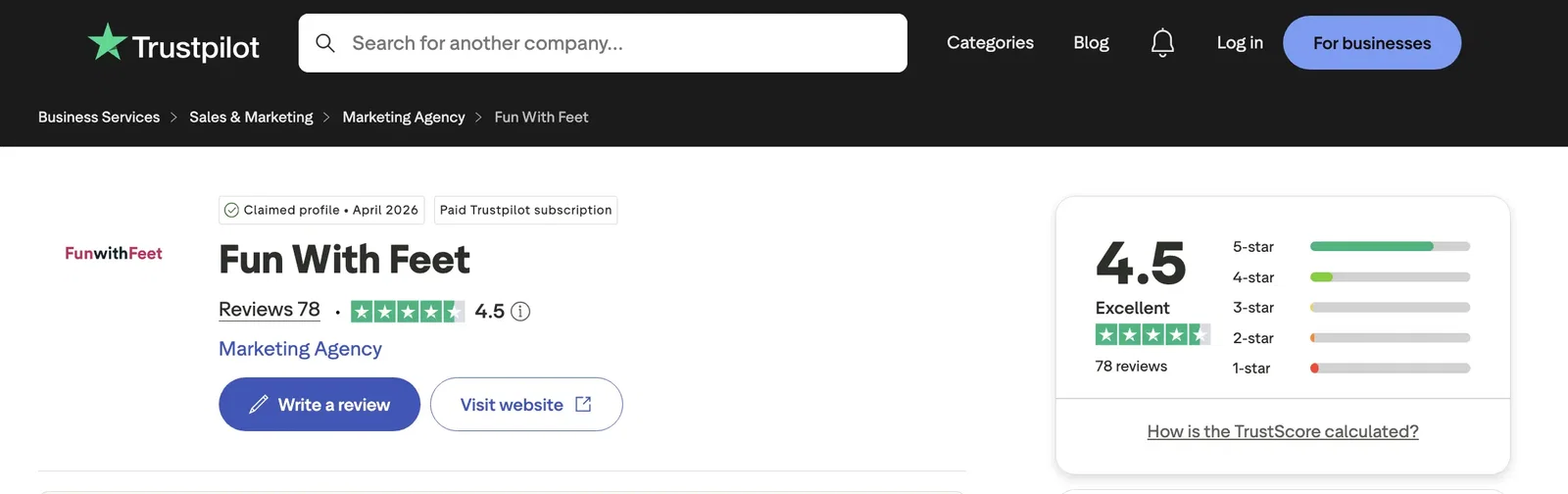
First, the profile is a claimed, paid Trustpilot profile, the company is categorised there as a marketing agency, and it actively invites customers to leave reviews.
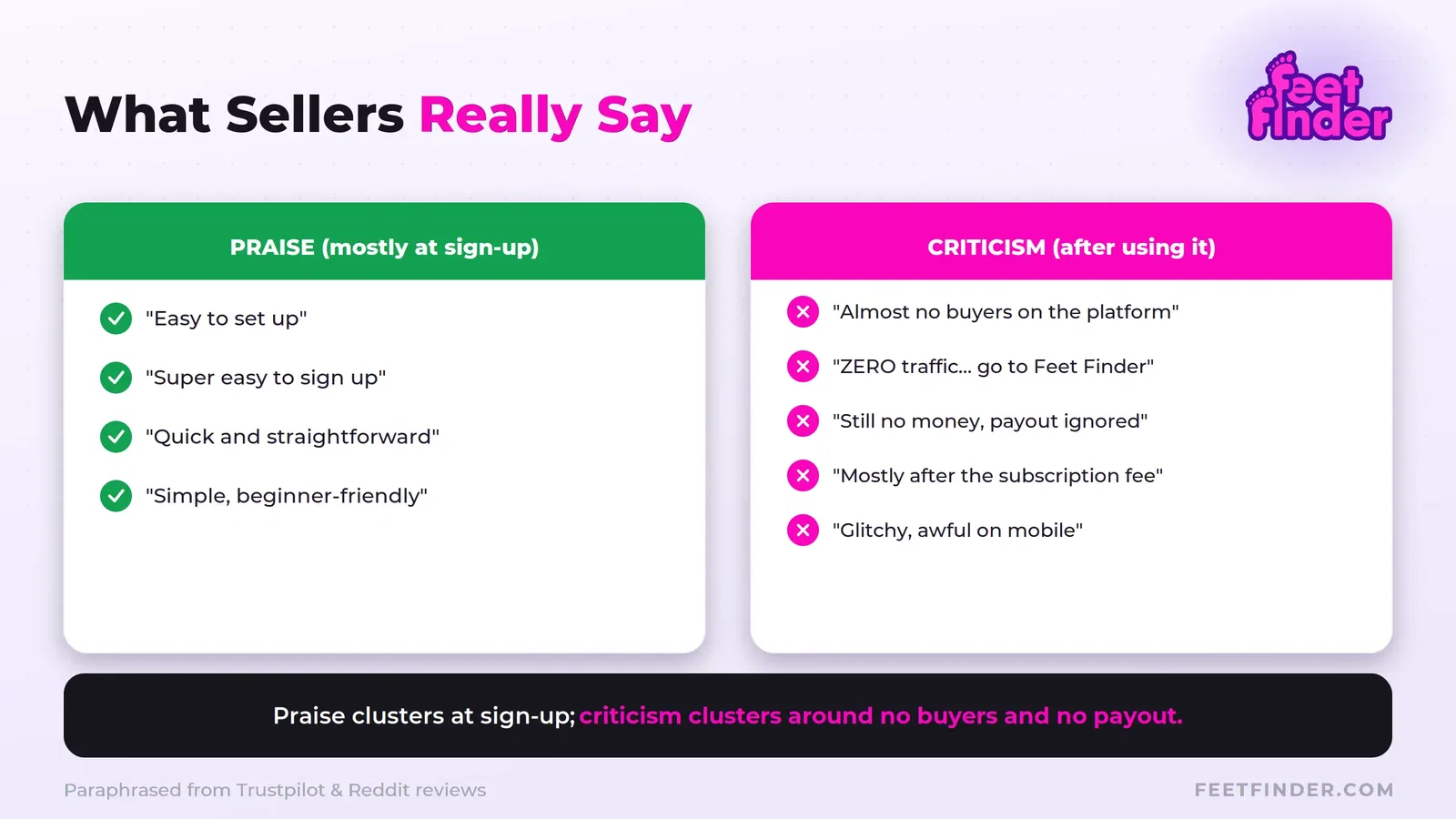
A large share of the five-star reviews are from invited users and are about the sign-up experience, with lines like "easy to set up," "super easy to sign up," and "quick and easy."
Those are real, but they are reviews of registration, not of earning money, and many are written days after joining, before any sales could realistically happen.
The critical reviews tell a different, more detailed story, and they are almost all about what happens after you actually try to use the platform.
One reviewer wrote that after less than a week on FeetFinder they had more profile views than in a whole month on Fun With Feet, called the upload experience "awful" and unusable on mobile, described "zero traffic," and ended with "my advice, go to Feet Finder."
Another, giving three stars, said it is "very difficult to get sales, especially if you want to be more discreet." Others reported the site crashing repeatedly and payouts going unpaid. Trustpilot itself notes the company has not replied to its negative reviews.
Reddit is even more blunt. In a long, highly-upvoted seller thread on r/feethustle titled "FunwithFeet Review: My Experience As A Seller," the consensus is harsh.
One seller wrote that they gave it "a fair try for like 3 months" and it "did NOT get better," adding that they much prefer FeetFinder and make a few hundred dollars a month there.
Another said Fun With Feet is "not worth it," that the company seems "mostly after the sellers subscription fee," and that "they have almost no buyers on the platform."
Several commenters describe switching to FeetFinder and only then starting to make sales, and a few use the word "scam" to describe their own experience of paying and earning nothing.
You should weight this the right way. Anonymous reviews are not proof, invited five-star reviews are not fake, and a few loud negatives do not define a platform.
But when the positive reviews cluster around "easy sign-up" and the negative reviews cluster around "no buyers, no traffic, and trouble getting paid," that split is the most useful signal you have, and it lines up exactly with the storefront-versus-marketplace problem.
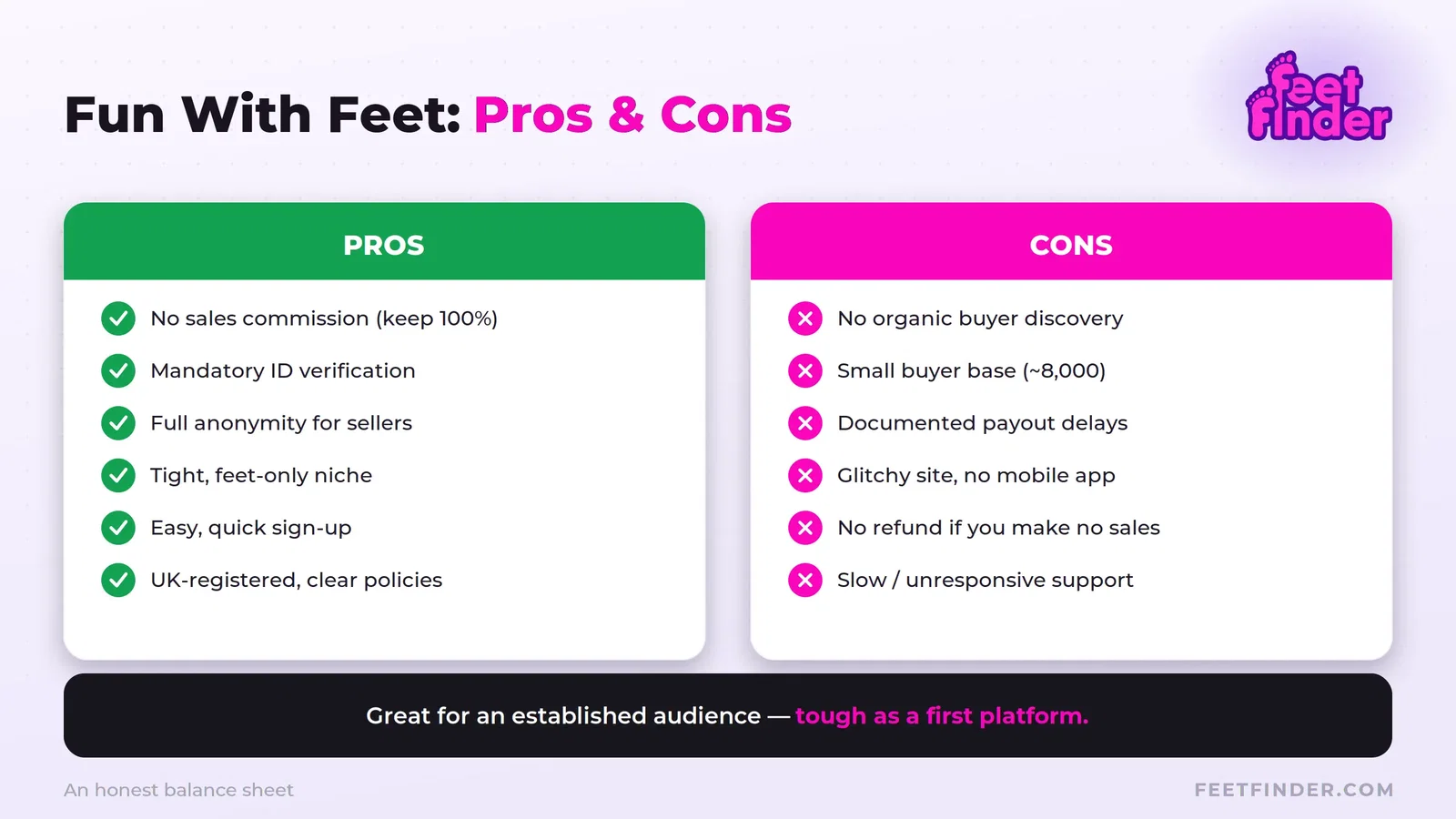
Fun With Feet Pros: What Genuinely Works
A fair review names the real strengths, and Fun With Feet has several:
-
A no-commission earnings model: The platform states sellers keep 100% of their sales, with the cost being the subscription rather than a percentage of each sale. For a seller who already has buyers, that is genuinely attractive.
-
Mandatory ID verification: Every creator is identity-verified, which raises the floor on authenticity and keeps out some bad actors.
-
Real anonymity: You can sell feet pics without ever showing your face, using a pseudonym and feet-only content. In this niche, that privacy is a core need, not a nice-to-have.
-
A tight, feet-only niche: No general nudity and no unrelated categories competing for attention. Buyers who are there want exactly what you sell.
-
A genuinely easy setup: The sign-up flow is quick and beginner-friendly, which is exactly what most of the positive reviews praise.
-
A UK-registered operator and clear policies: The company (GYCO Online Limited) is registered in England and Wales, publishes terms, a refund policy, a content-complaints process, DMCA and 2257 statements, and commits to resolving content complaints within seven business days. That legal footing is a real trust signal.
-
Low upfront cost to test: The subscription is inexpensive, so trying the platform is not a big financial commitment.
Fun With Feet Cons: The Real Limitations
These are the issues that show up again and again across independent reviews and the platform's own documentation:
-
No organic buyer discovery: This is the core problem. The platform does not surface new profiles to buyers algorithmically, so a creator with no outside audience will struggle to generate meaningful sales. It is structural, not a bug, but it makes Fun With Feet a poor starting platform for anyone building from zero.
-
A small buyer base: The platform advertises being trusted by 8,000-plus buyers. That is modest in this market, and reviewers consistently describe far fewer buyers than on larger sites, which means less demand for your content even if you do drive traffic.
-
Documented payout problems: Multiple dated Trustpilot reviews describe requesting earned payouts and not receiving them for weeks, with support going silent. This is the most serious concern on the list, and it is about money you have already earned.
-
A glitchy site, especially on mobile: With no dedicated app, everything runs in the browser, and reviewers describe the upload experience as awful on a phone and the site as crashing.
-
A refund policy that excludes the most common complaint: The platform's own refund policy states that refunds will not be granted if "a user did not receive the sales or earnings they expected" or if "creator earnings are lower than anticipated." In plain terms, if you pay the subscription and make nothing, you are not getting that money back.
-
Limited support responsiveness: Several sellers report slow or ignored support, particularly around payouts, and Trustpilot notes the company does not reply to negative reviews there.
-
Limited security transparency: For a platform that collects government ID and processes payments, there is limited public detail on data protection and security practices, which is worth weighing before you upload your ID.
Honest framing: None of this makes Fun With Feet an outright bad actor. It makes it a small storefront with small-platform problems, and one policy and payout pattern that new sellers, in particular, should not ignore.
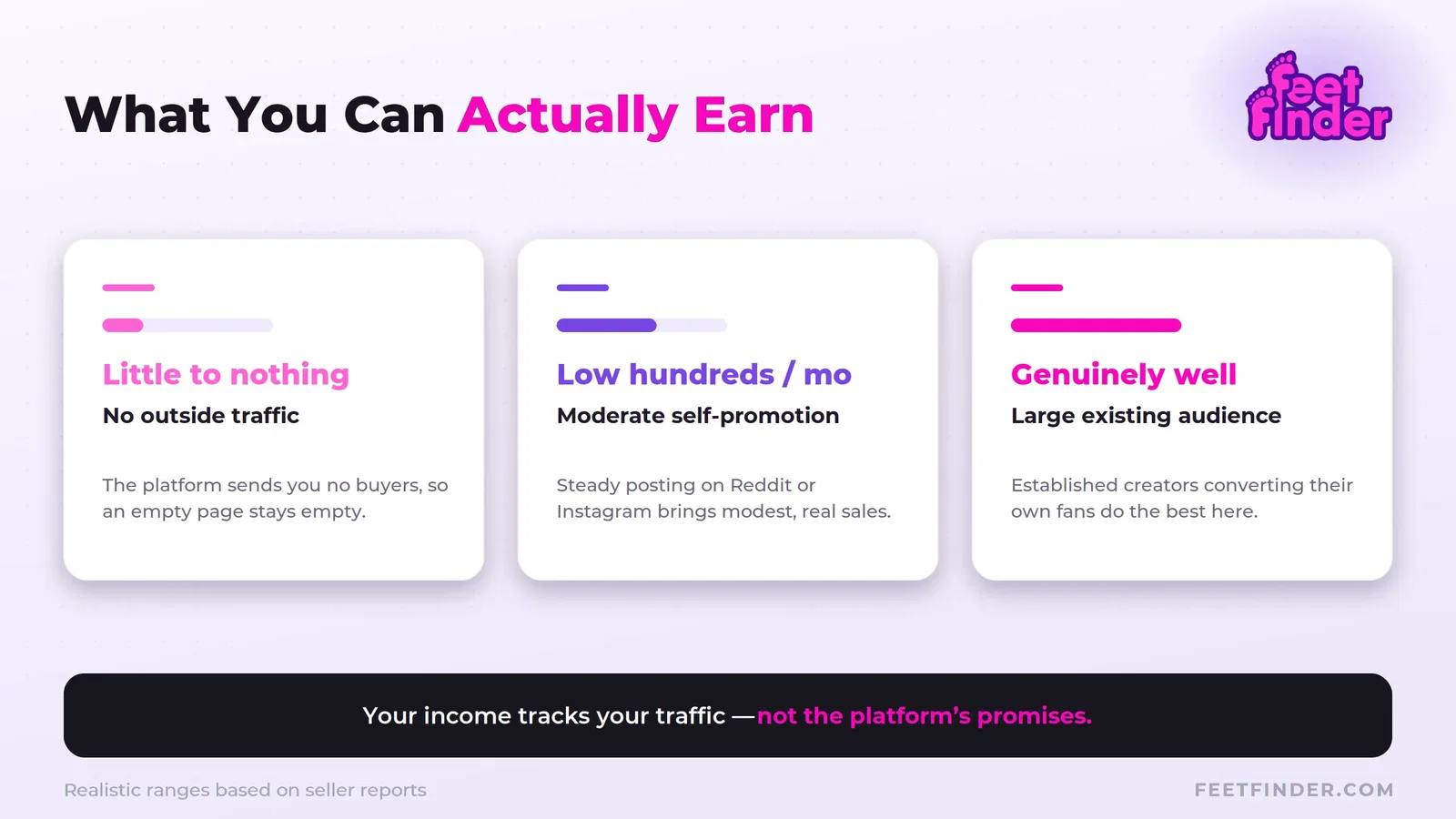
How Much Can You Actually Earn on Fun With Feet?
This is where honesty matters most, because the most misleading content in this niche is about earnings. The truthful answer is that your income depends far more on the traffic you bring than on the platform itself.
Based on the pattern across seller reviews, a realistic picture looks like this. In the first few months with no outside promotion, many sellers make little to nothing. With moderate self-promotion on Reddit or Instagram, modest earnings in the low hundreds per month are achievable.
And sellers who already bring a large, engaged outside audience can do genuinely well. The common thread is that the platform is not generating those earnings; your own marketing is.
This is exactly why the same content tends to earn more on a marketplace.
Sellers who cross-post frequently report a stark difference, and even competing review sites concede that a larger, discovery-driven platform like FeetFinder produces higher average creator earnings because new sellers there have a path to early sales that then builds momentum.
On a storefront, you have to solve the traffic problem entirely by yourself first, which most beginners never do.
If you take one number away, make it this: on Fun With Feet, a beginner with no audience should expect the platform, by itself, to deliver very little. That is not pessimism; it is what the architecture and the reviews both point to.
Fun With Feet Refund and Cancellation Policy (How to Cancel Your Subscription)
Because Fun With Feet sells access to digital services, its refund policy (effective 5 March 2026) is restrictive, and it is worth reading before you pay. Refunds may be granted for fraudulent or unauthorised transactions, duplicate payments, billing-system errors, or a verified technical fault that prevents access to purchased content.
Refunds are explicitly not granted if you simply change your mind, if you cancel after a billing cycle has started, if you are dissatisfied with the service, and, most importantly for sellers, if "a user did not receive the sales or earnings they expected" or "creator earnings are lower than anticipated."
That last part is the crucial one: the single most common seller complaint, paying and not earning, is specifically excluded from refunds.
To cancel a Fun With Feet subscription, do it from your account settings before your renewal date so you are not billed for the next period, and keep a written record of the request.
Interestingly, some sellers who struggled to get payout support answered still reported that their subscription cancellation was processed promptly, so the cancellation itself is usually the easy part.
The practical lesson: never treat the subscription as refundable insurance. Treat it as money spent, and only spend it if you already have a way to bring buyers.
Fun With Feet Payment Methods, Withdrawals and Payout Timeline
When a buyer purchases your content, the money is credited to your Fun With Feet balance, and you then request a withdrawal to your bank account. Buyers pay with major cards, including Visa, Mastercard, and Maestro, through the platform's encrypted checkout, so you are never handling a buyer's card details directly.
The weak spot is on the payout side. Bank transfer is the primary withdrawal route, and details on alternatives such as international options are not clearly published.
That matters if you are outside the platform's core markets: on Reddit, sellers from countries including those in South America describe struggling to fund a subscription without a standard credit card, or to get a payout method approved at all. It is worth checking whether your country and bank are supported before you pay.
Just as important, Fun With Feet does not publish a clear payout timeline or service-level commitment. Creator reports vary widely, and, as covered earlier, several sellers describe withdrawals sitting unpaid for weeks with no explanation.
Without a published schedule, you cannot plan your cash flow with any confidence, which is a real drawback for anyone treating this as income rather than pocket money.
In fairness, no platform is perfect on availability: FeetFinder, for example, is available in many countries but not every single one, so international sellers should confirm support there too.
The difference is that FeetFinder publishes a weekly payout schedule, which removes most of the uncertainty that Fun With Feet sellers describe around getting paid.
Is Fun With Feet Safe? Privacy and Security
On the basics, Fun With Feet is reasonably safe to use. It verifies identities, keeps sellers anonymous behind a display name, processes payments through the platform rather than peer-to-peer, and advertises encrypted, discreet transactions.
That is meaningfully safer than trying to sell through social-media direct messages, where scams and chargebacks are rampant.
The weaker areas are transparency and buyer-side friction. For a platform that collects government ID and handles payment and payout data, there is limited public detail on its security and data-protection practices, which is something privacy-conscious sellers should factor in.
And while buyer anonymity protects buyers, it can leave sellers dealing with lowballers and time-wasters.
Selling feet pictures is legal in most countries, but the content and age-verification rules you face depend on your own location, so check local laws before you start.
For comparison, this is one area where a larger platform tends to do better: FeetFinder verifies both buyers and sellers by ID and age, runs anonymous, PCI-compliant checkout, and publishes clearer trust and safety information, which reduces both fraud and the volume of non-serious buyers you have to filter.
Selling Feet Pics Safely: Legal and Practical Tips
Whichever platform you choose, a few habits protect your income, your privacy, and your peace of mind. These apply to Fun With Feet, FeetFinder, Onlyfeet, OnlyFans and anywhere else you sell:
-
Watermark your previews: Free preview images are the most likely to be copied and reshared. A discreet watermark deters theft without ruining the preview, and it is your first line of defence against leaks.
-
Protect your anonymity deliberately: Keep your face, tattoos, unique jewellery, and identifiable backgrounds out of shots if you want to stay private. Use a pseudonym, and never share personal contact details with buyers.
-
Keep every payment on-platform: The most common scam in this niche is a buyer trying to move you off-site or asking you to accept gift cards or a direct bank transfer, often "as a deposit." Legitimate buyers pay through the platform. On-platform payment is what protects you from chargebacks and fraud.
-
Prefer platforms that verify both sides: Two-sided ID and age verification dramatically reduces scammers and time-wasters. It is one of the clearest safety advantages a marketplace like FeetFinder has over lighter-verification setups.
-
Know your local law: Selling feet content is legal in most places, but rules differ by country and, in the US, increasingly by state, where age-verification requirements for adult platforms are expanding. Check what applies where you live before you start.
-
Treat it as a real business: Income from selling content is taxable in most jurisdictions. Keep records of your earnings and expenses, and speak to a tax professional about your specific situation.
None of this is meant to scare you off; selling feet content is a legitimate way to earn. The point is that the sellers who last are the ones who stay anonymous by design, keep their money on secure platforms, and treat the whole thing professionally.
Fun With Feet vs FeetFinder: The Honest Comparison
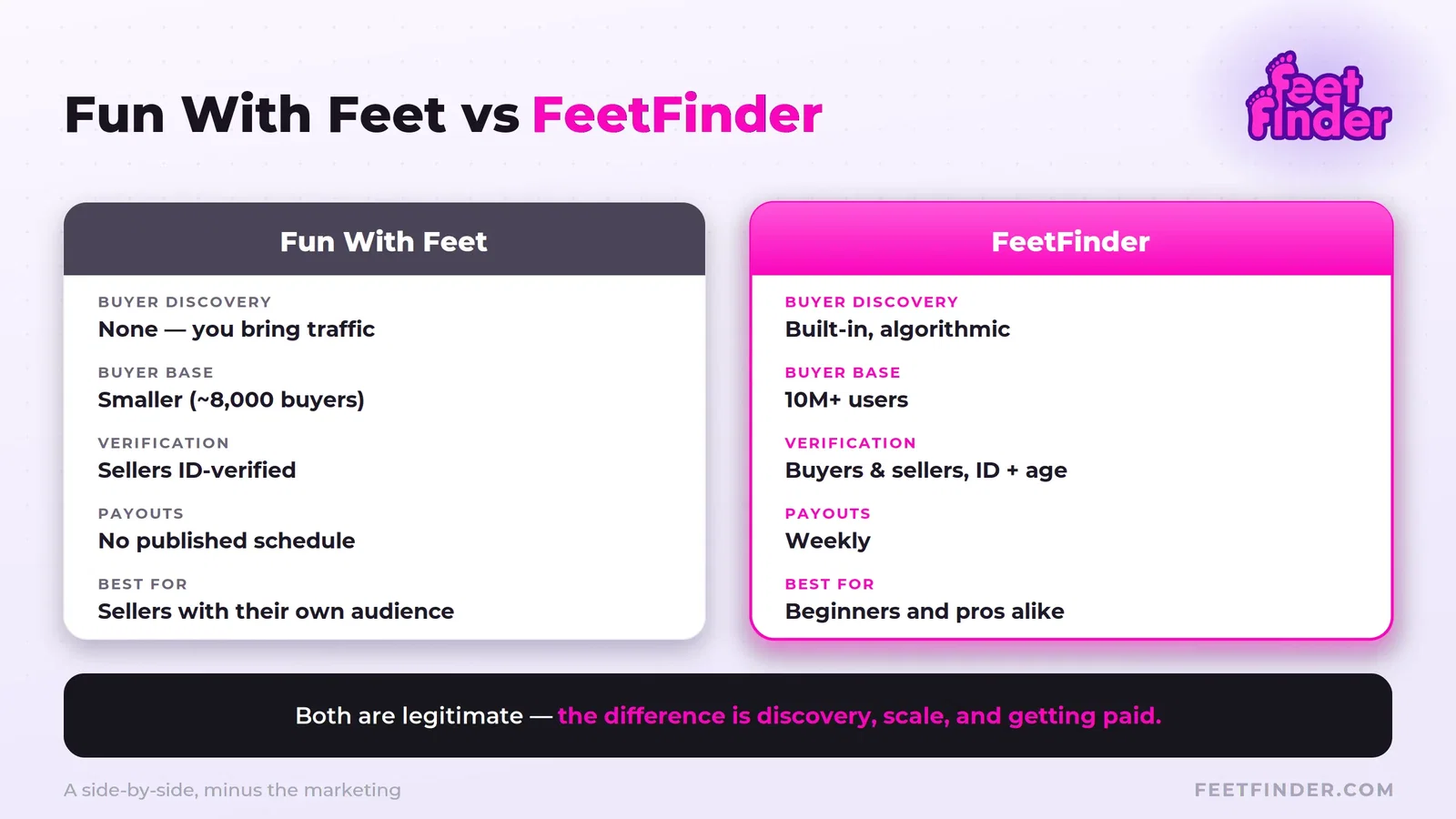
This is the comparison most sellers actually search for, so let us be direct and fair. Both platforms are legitimate, both verify identity, and both keep sellers anonymous. The differences are in scale, discovery, and how reliably you get paid.
FeetFinder is the market leader, with more than 10 million users, 15M+ pieces of content sold, and a buyer base many times larger than Fun With Feet's roughly 8,000 buyers.
Crucially, it is a true marketplace with algorithmic discovery, so new creators can get views and sales without an existing audience.
It verifies both buyers and sellers by ID and age, runs anonymous, PCI-compliant checkout, and pays out on a weekly schedule.
Even sellers who complain about the usual industry problem of occasional scam buyers tend to praise FeetFinder's support for shutting those accounts down.
Fun With Feet, by contrast, is a smaller storefront. It sends far less buyer traffic, relies on you to market your own page, and carries the documented payout and mobile-usability complaints covered above.
Its genuine advantages, no sales commission and a tight niche, mostly benefit sellers who already have their own audience.
The tell-tale detail is that this is not just our conclusion. Across the Reddit thread and the Trustpilot reviews we examined, seller after seller independently reached the same verdict, several of them explicitly saying they moved to FeetFinder and only then started making sales. When a competitor's own strongest critics keep recommending your platform, that is meaningful.
If you are choosing one place to start, and you want the best odds of real sales with the least hassle around discovery and payouts, FeetFinder is the stronger choice.
Fun With Feet makes the most sense as a secondary storefront once you are already established and bringing your own buyers.
Start where the buyers actually are
FeetFinder brings buyers to you through built-in discovery, verifies everyone by ID and age, keeps checkout anonymous, and pays weekly. You keep the majority of every sale, and you are not paying upfront for an empty shop.
Create your FeetFinder profile →
Who Should Use Fun With Feet, and Who Should Not
The right answer genuinely depends on the kind of seller you are.
Fun With Feet is a reasonable fit if you:
-
Already have an outside audience on Reddit, Instagram, TikTok, or X that you can point at your page.
-
Understand it is a storefront, not a marketplace, and are ready to do your own marketing.
-
Want a feet-only, no-commission environment and are comfortable with a smaller buyer base.
-
Are diversifying across platforms rather than relying on this as your only income.
Fun With Feet is a poor fit if you:
-
Are a brand-new creator with no social following and expect the platform to bring buyers.
-
Need organic discovery to build early momentum and confidence.
-
Cannot or will not promote yourself externally.
-
Want reliable, predictable payouts and clear support, given the documented payout complaints.
-
Are looking for the easiest, lowest-risk entry point into selling feet content.
How to Sign Up for Fun With Feet
If you have decided it fits your situation, here is the process from start to first payout. Create your account with an email and password, and confirm you are 18 or older. Choose and pay for a subscription plan.
Verify your identity by uploading a government-issued ID, which is required and typically processed within a day or two.
Next, add your bank details for withdrawals, build your profile with a bio and a feet-focused profile picture, and upload your content into priced galleries with some free previews.
Then, and this is the step that actually determines your income, start promoting your profile on the outside platforms where your audience already is. The site will not send you traffic, so your own promotion is the engine.
Set aside an hour or two for setup, and be realistic that the ongoing work is content creation and external marketing, not just uploading and waiting.
The Better Starting Point: Why Most Sellers Begin With FeetFinder
If the honest problem with Fun With Feet is that it does not bring you buyers, then the honest solution is to start where the buyers already are.
That is the case for FeetFinder as a first platform, and it is exactly the move that so many Fun With Feet reviewers describe making.
FeetFinder is built as a marketplace, so its discovery does the introduction for you: buyers search, browse, and find new creators, which means you can earn early without first building an audience elsewhere.
Every buyer and seller is ID and age verified, checkout is anonymous and PCI-compliant, and payouts run weekly, which directly addresses the two things Fun With Feet sellers complain about most, buyer traffic and getting paid.
With more than 10 million users and 15M+ pieces of content sold, the demand side simply exists at a scale a small storefront cannot match.
None of this means you can only use one platform.
A smart, established seller can run both, using FeetFinder for discovery and reliable payouts, and adding Fun With Feet as an extra storefront for an audience they already control.
But if you are starting out and want the best odds of your first real sale, begin with the marketplace.
Ready to actually get found?
Join a verified marketplace with real buyer discovery, ID and age checks on both sides, anonymous checkout, and weekly payouts. Thousands of creators are already earning on FeetFinder.
Fun With Feet FAQs
Is Fun With Feet legit?
Yes. Fun With Feet is a legitimate, UK-registered platform (operated by GYCO Online Limited) that verifies identities and processes real payments, and many sellers do get paid.
It is not a scam in the legal sense. That said, reviews are mixed, with common complaints about limited buyer traffic and, in several documented cases, delayed or unpaid payouts.
For higher and more reliable sales, most sellers do better on a larger marketplace like FeetFinder.
Is Fun With Feet a scam?
No, it is not a scam. It is a real, operating company that pays many sellers.
Some users describe it as a scam because they pay the subscription and make no sales, or because they experienced delayed payouts, but that reflects the platform's storefront model and specific service issues rather than deliberate fraud.
Results vary widely, so it is not a guaranteed income source.
Is Fun With Feet safe?
The basics are covered: identities are verified, sellers stay anonymous, and payments run through the platform.
The weaker points are limited public transparency around security and data handling, and lighter buyer-side friction that can expose sellers to time-wasters.
FeetFinder, by comparison, verifies both buyers and sellers by ID and age and publishes clearer trust and safety information.
How much can you make on Fun With Feet?
It depends almost entirely on the traffic you bring, because the platform does not surface your profile to buyers. With no outside promotion, many sellers make little to nothing.
With steady self-promotion, modest earnings in the low hundreds per month are realistic. Sellers with a large existing audience can do well.
The same content typically earns more on a discovery-driven marketplace like FeetFinder.
Is FeetFinder better than Fun With Feet?
For most sellers focused on actual sales, yes.
FeetFinder is a true marketplace with algorithmic buyer discovery, a much larger verified buyer base, mandatory ID and age verification on both sides, and weekly payouts.
Fun With Feet is a smaller storefront that relies on you to bring your own traffic and has documented payout complaints.
Fun With Feet can still work as a secondary platform for creators who already have an audience.
How does Fun With Feet work?
Sellers pay a subscription, verify their ID, build a profile, upload feet photos and videos, and set their own prices.
Buyers join free, browse profiles, and pay to unlock content. Money lands in your platform balance, and you withdraw it to your bank.
The platform does not send buyers to your page, so you must promote your profile externally.
How do I cancel my Fun With Feet subscription?
Cancel from your account settings before your renewal date so you are not charged for the next period, and keep a written record of the request. Note that the refund policy does not cover you if you simply did not make sales, so the subscription should be treated as money already spent.
Does Fun With Feet have an app?
No. There is no dedicated mobile app; the platform runs through the website in a browser. Several reviewers describe the mobile web experience as glitchy and difficult to use for uploads.
Does Fun With Feet take a commission?
According to the platform's own seller FAQ, no; it states that creators keep 100% of their earnings, with the cost being the subscription rather than a per-sale commission. Treat conflicting third-party commission claims with caution. The meaningful cost is the upfront subscription, which is not refundable if you make no sales.
Is it worth signing up for Fun With Feet?
It is worth it if you already have an outside audience you can direct to your page and you want a low-commission, feet-only storefront.
It is not worth it as a first or only platform if you have no audience, because the site will not bring you buyers.
In that case, starting on a marketplace like FeetFinder gives you a far better chance at real sales.
Final Verdict: Should You Join Fun With Feet in 2026?
Fun With Feet is not a bad platform, and it is not a scam. It is a legitimate, UK-registered, feet-only storefront that works genuinely well for one kind of seller: an established creator with their own audience who wants a low-commission place to convert existing fans into buyers.
For that person, the anonymity, the niche focus, and keeping 100% of sales are real advantages.
For everyone else, and especially for beginners, the honest picture is harder.
The platform does not bring you buyers, the buyer base is small, the site can be glitchy on mobile, the refund policy specifically excludes the most common complaint, and a number of sellers have documented real trouble getting paid.
Those are not reasons to panic, but they are reasons to go in with your eyes open, and strong reasons not to make Fun With Feet your first or only platform.
The reviews that call it "a scam, made nothing" are usually right about their own experience but wrong about the cause; the reviews that call it "the best platform ever" are usually right about the ease of sign-up but quiet about the audience they already had.
The truth sits in between, and it points to a simple plan: if you are starting out, build your presence first on a marketplace with real buyer discovery and reliable weekly payouts, like FeetFinder, and only add smaller storefronts once you have an audience of your own.
Choose based on your actual situation, not on marketing in either direction, and you will make the decision that puts money in your account rather than out of it.
Reviewed & written by
Trevor
Trevor specializes in creating practical how-to guides for new content creators. His work focuses on profile optimization, attracting buyers, avoiding common mistakes, and understanding platform policies. Rather than relying on marketing claims, he emphas
Knock Knock!! Let Your Feet Earn Money
Join thousands of users who are making money by buying and selling feet pictures in a safe, secure platform. Start your journey today with FeetFinder's trusted marketplace.